

Civilizational Agency
(12,000–5,000 years BP)
Culture encompasses shared knowledge, languages, arts, beliefs, practices and structures communicated across generations. During the Neolithic period of the Cultural Intelligence evolution phase, civilizations formed around complex amalgamations of cultural attributes in given regions. Civilization can be seen as the large-scale, organized expression of culture in which cultural practices form the basis of persistent collective structures such as political and economic frameworks. By understanding civilization as an extension and elaboration of culture, we can better appreciate how Cultural Intelligence is not just about the accumulation of knowledge, but about the agentic use of it to create physical systems and social institutions that lay the basis for the next stage of human Intelligence evolution.
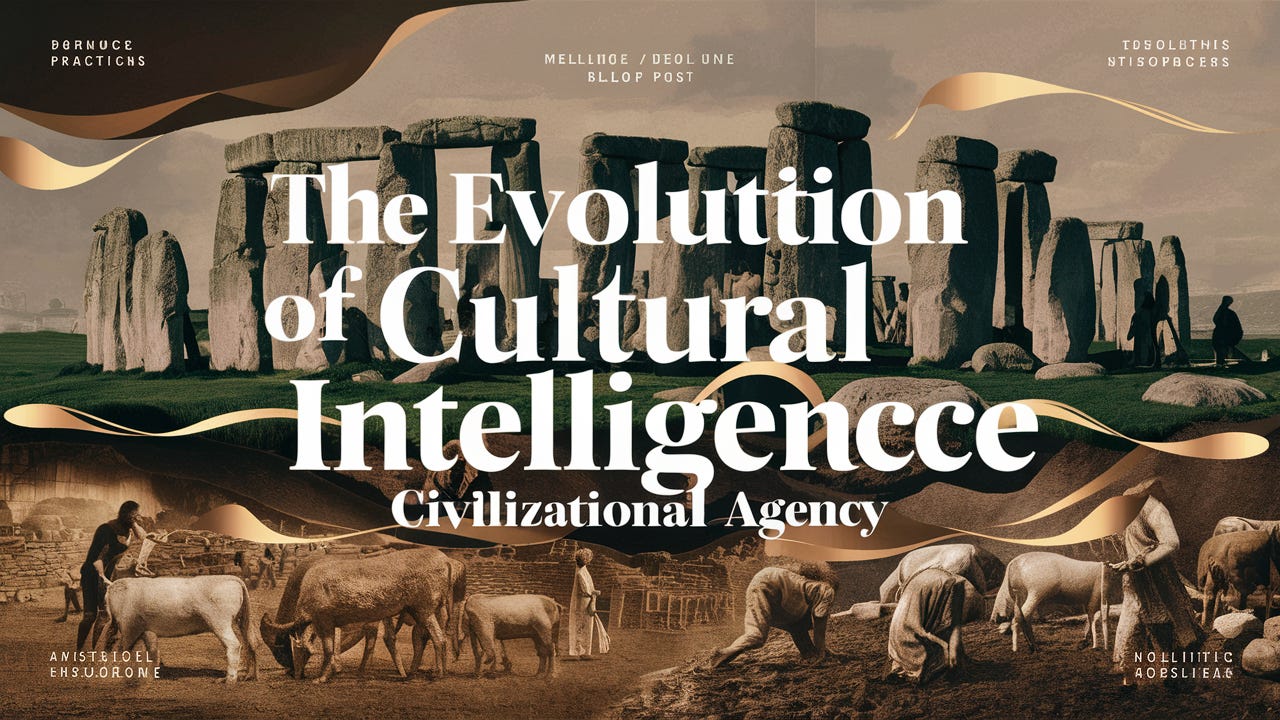
The Neolithic period saw a powerful resurgence of outwardly-directed energy as humans emerged from their long, wintery introspective phase to proactively shape their contextual environment. A significant stage of human Cultural Intelligence evolution unfolded as the vast glacial ice sheets receded, marked by the development of settled communities, agriculture, animal domestication, new practical innovations such as pottery and weaving and the construction of megalithic structures and sites.
Whereas in previous ages early hominins were molded by the intelligence of the natural environment, it was now humans who became the intelligent force of environmental pressure, laying claim upon the land and its inhabiting life force, intentionally harnessing and directing its power. This was the assertion of human agency and the birth of civilization.
The Compositional Agency stage involved the human cognition that the world is comprised of discrete objects and that those objects had composition. It also involved the human agentic activity of decomposing and recomposing environmentally available resources in complex and useful ways.
During the Civilizational Agency stage, humans recognized the objective nature of the land and all of its features and attributes, the plants, the animals and individualized and collective humanity. They then proceeded to exercise their agency by organizing and recomposing these elements into new and useful structures.
Humans extended Civilizational Agency over the land and began to settle into agricultural communities, establishing zones of dominion in which they were the uncontested power. The development of permanent settlements, agriculture and animal husbandry ended the predominance of the nomadic lifestyle. Humans intelligently evolved from adaptive hunter-gatherers to agentic builder-cultivators.
Cultural Intelligence began to aggregate around communal living in ways that would not have been possible under nomadic conditions. In a settled, persistent context cultural knowledge could be shared, developed and preserved across generations. Sedentary living allowed for increased social cooperation, specialized crafts and organizational knowledge applied at scale, enabling the creation of food surpluses. Pottery was created to prepare food and store surplus produce and transport it for trade.
Both agriculture and animal husbandry were creative and assertive extensions of human agentic intelligence into the realms of plant and animal life. Humans began to harness the biological intelligence powers of other species for their own development. The creation of bread wheat from native grasses and the evolution of dogs from wild wolves are prime examples of this process.
The intelligent human utilization of environmentally available resources such as stone, fire, bone and wood contrasts significantly with the agricultural domestication of plants and animals. The former required observation and utilization of the compositional nature of simple forms of matter whereas the latter involved the observation and appropriation of the properties and life cycles of complex organic intelligences. The planned cultivation of plants signified the directed harnessing of the life force itself. Likewise, the taming and breeding of animals extended the power of human intelligence to the governance and mastery of other sentient life forms and the beginning of a symbiotic relationship between humans and domesticated animals as labor, transportation, food and companionship.
The light of human observational awareness fell upon the plant kingdom and it was noticed that plants arose from seeds. Incipient agriculture in the vicinity of temporary settlements gradually led to intentional planting in permanent communities.
The domestication of wheat involved an ongoing directed process of selective breeding and experimentation, as Neolithic farmers carefully selected and propagated desirable traits over multiple generations. This process of artificial selection was a proto-scientific application of human intelligence to the manipulation of plant genetics. Some degree of serendipity was no doubt a factor, but each development, whether the result of conscious intent or chance, required the farmer to apply causal reasoning to the next iteration of selective cultivation. The creation of bread wheat was a highly agentic expression of human will and creativity.
In contrast, the human domestication of dogs from wolves was a more fluidly organic and serendipitous process, emerging from the complex interactions between the two intelligent species over time. This process was shaped by the agency and preferences of both humans and canines, as they adapted to each other’s presence and co-evolved new forms of social and ecological interaction.
Despite these differences, both processes were deeply cultural and social in nature, relying on the accumulated knowledge, practices and values of human societies over generations. The experiences of the domestication of wheat and dogs were pivotal in the development of human ecological intelligence. It is an extension of human intelligent awareness, understanding and will into and through the environment to a degree previously unrealized.
The Neolithic period thus represents a significant transformation in the nature and direction of human intelligence, as humans began to actively shape their environment and their relationships with other species through a combination of intentional experimentation and organic adaptation. The collective Cultural Intelligence of humanity evolved during the Neolithic Age to extend its agency beyond the species itself into the natural world, bringing the land, plants and animals within its growing sphere of influence and transforming them.
One of the salient aspects of Civilizational Agency was the construction of large scale megalithic structures and sites, a phenomenon seen at this stage of human Cultural Intelligence evolution across societies all over the world.
Sedentary living, agriculture and animal husbandry generated a rapid increase in population size and density. The availability of this new latent labor force was likely one of many factors that combined to result in the construction of megalithic structures and sites.
As noted in our study of the Cultural Meaning stage, in spite of the harsh conditions presented by Ice Age conditions, humans dedicated significant time and resources into externalizing inner meaning in the forms of Paleolithic artworks. Humanity next went from these intimate, personal and small group expressions of its nascent noumenal intelligence to large scale, collectivized long term construction projects. The Intelligence evolution of Cultural Meaning was amplified and writ large upon the surface of the earth during the Civilizational Agency stage in the form of the great human Megaliths.
The enormous stone structures and complexes were not cities for working or living, but rather served primarily ceremonial and spiritual functions. Their construction was frequently aligned with astronomical phenomena and embodied mathematical principles. The largest, most enduring and most physical projects of human prehistory were expressions of inner, ephemeral human noumenal intelligence.
With the Megalithic sites, the Temporal-Spatial dynamic seemed to predominate. Many of the features of these installations related to calendrical and celestial time keeping functions. The enduring construction of the colossal structures also speaks to the temporal element. Like the handprint outlines on Paleolithic cave walls, the Megaliths are a stamp of human presence on the landscape, a spatial registration of mortal immortality.
It is perhaps during this stage that the Discrete-Cultural Intelligence dynamic first becomes significant. It is rather clear that significant degrees of labor specialization and social stratification emerged. There were very likely classes of farmers, builders and ecclesiastics that grew up around the particular knowledge sets specific to agriculture, animal husbandry, construction and spiritual and celestial knowledge. It may be that the first leadership classes formed from among the shamanistic priests who governed the spiritual life that revolved around the megaliths.
If the human Cultural Intelligence phase of evolution can be analogized to an interplanetary space mission, the Cultural Meaning stage was the countdown preparation to launch and the Civilizational Agency phase was ignition and liftoff. Next humanity would rocket into the stratosphere with Agentic Force it expressed itself outwardly through newly discovered and invented Force carrying vectors.
(Part of a series and a larger work-in-progress)