

Conquest, Slavery and Agentic Force in the Ancient World
Prior to the age of Agentic Force, human cultural evolution had been relatively distributed and homogenous. Over long periods of time, features that arose in one region tended to arise in others and the slow diffusion of knowledge and cultural attributes led to a relatively flat distribution of cultural development.
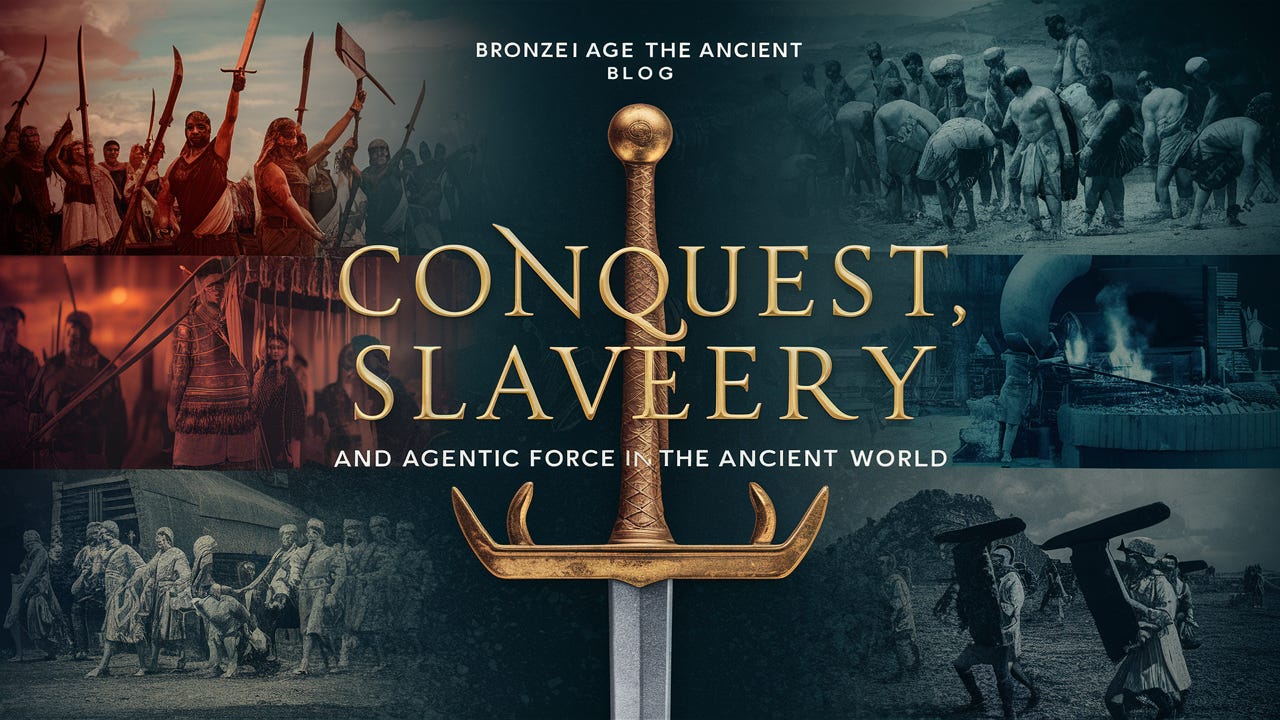
The period of Agentic Force, however, saw the rise of complex civilizations defined by territorial boundaries and enforced by military power. As a result human Cultural Intelligence differentiated into distinct national and ethnic characteristics and specializations. Each pocket of human culture developed a special set of attributes that has been a source of resiliency as well as conflict throughout history.
While earlier societies exhibited more homogenous social structures, the era saw the establishment of distinct social classes, occupations, and roles within society. Specialization led to a depth of knowledge, skill and productivity that would not have been otherwise possible, but also resulted in inequality of power, status and wealth.
During the stage of Agentic Force, the first structured forms of social organization emerged. Human society self-organized into cohesive entities across every domain of human endeavor, including the specialized function classes of rulership, priesthood, intellectuals, military, managers, merchants, artists, artisans, laborers and slaves.
With regards to political structures, there was a shift from tribal leadership or small chiefdoms to centralized states with powerful rulers who were often considered divine or semi-divine figures. Examples include the pharaohs in Egypt, emperors in China, and kings in Mesopotamia. Bureaucratic systems to manage state affairs were instituted to collect taxes, maintain law and order, and oversee public works projects. Competition for resources, land, and control of trade routes drove the creation of military organizations and standing armies with advanced weaponry.
Economic systems developed around agricultural techniques, craft specialization, trade, commerce, currency and markets. Irrigation systems, plows, and crop rotation, led to increased food production and population growth. The expansion of trade networks, both local and long-distance, facilitated the exchange of goods, ideas, and technologies. This led to the growth of merchant classes and the development of economic specialization. The emergence of specialized crafts and industries, such as metalworking, pottery, weaving, and construction was supported by the surplus resources generated by agricultural intensification and trade. The development of standardized currencies and marketplaces facilitated economic exchange and the complexification of economics.
Social organization was a Force multiplier. The efficient division of labor into roles, the stratification of the population into classes and the centralization of authority into states gave birth to economics, increased productivity, accelerated innovation and facilitated the realization of large scale collective goals and projects.
Slavery
The Neolithic recruitment of animal Force as labor as well as the communal efforts involved in the construction of the great megalithic sites naturally evolved into the social organization of human labor Force during the Agentic Force stage. This included the widespread practice of slavery.
Abhorrent to our contemporary sensibilities, slavery seemed like a social good to the cultures of the time. In the Bronze Age, slavery was an accepted and normalized institution across various societies, integrated into economic, legal, and social structures. Slaves were primarily seen as property but were sometimes granted limited rights, depending on their role and society’s norms. Religious, legal, and administrative sources indicate a worldview in which slavery was considered a natural and necessary part of the social hierarchy. Captives of war often became slave labor.
War
Like slavery, wars of conquest are regarded as reprehensible when viewed through the lens of our present day worldview, but it was accepted as the normal course of human affairs in the ancient world. During the Agentic Force stage war and conquest were generally accepted and often celebrated as natural and were frequently justified through religious and ideological beliefs. Like slavery, war was deeply integrated into the cultural, social, and economic structures of the time, with kings and elites often using warfare to demonstrate their power, secure resources, and maintain their authority.
Warfare during the Agentic Force stage evolved significantly in scale, technology, and strategy. The rise of organized armies, advanced weaponry, and territorial ambitions transformed warfare into a systematic and professionalized institution. This period saw the rise and fall of empires, the development of formalized military strategies, and the increasing aggressiveness of campaigns driven by economic and political motivations. The increased scale and intensity of warfare reflected the broader societal changes of the period, including urbanization, technological innovation, and the emergence of complex social hierarchies.
Adaptation-Agency Dynamic and Agentic Force
It seems perhaps paradoxical that the same period which created marvelous cities, writing systems, mathematics, metal alloys, the wheel and complex social structures also manifested such destructive behaviors as war and slavery. But we may find an understanding of this apparent incongruity in the natural behavior of Intelligence as a general principle.
Intelligence, as a general principle, is expansive in nature. This may be the very significance of the “Big Bang” and the apparent expansion of the Universe. In all times and in all places, Intelligence tends towards its increase in scope, scale and depth.
Intelligence does not run in place or obtain in stasis. It is an active principle. There is an inherent “grow or die” imperative observably at work in all Intelligent Systems. That which is not growing is necessarily dying.
Human Cultural Intelligence seeks to spread, occupy space, reproduce and extend itself through time. The imperative of growth and expansion embedded in all human Intelligence — and Intelligence as a general principle — drove humans to extend agency over lands, resources, peoples and individuals. Viewed as a type of Intelligent System, it is propelled by the same inherent “expand or die” imperative that characterizes all Intelligence.
The Adaptation-Agency dynamic drove human Intelligence evolution forward from the earliest stage of Compositional Agency through to the stage of Agentic Force. At each stage, humans were forced to adapt to environmental pressures, intelligently countering with agentic responses. With the stage of Agentic Force humans moved largely beyond the survival and subsistence imperatives.
With the governor of environmental pressure almost entirely removed the Agentic Force of humanity was free to maximize its extension. The only regulating mechanism was then the opposition of other human agencies and the limits of self-destructive behavior. Adaptive pressures then originated from within the increasingly complex system of human Intelligence evolution itself. The primary force of adaptation became self-generated through human Cultural Intelligence.
Our contemporary worldview considers Force to be natural when it operates unconsciously as a consequence of universal law. Conversely, it is considered unnatural when directed by a conscious agent. But if conceptualized as an inherent feature of all Intelligent Systems, whether agentic or not, Force can be seen as the natural tendency of a system to explore the full range of its Adaptation-Agency dynamic over the course of its evolutionary process.
Slavery and war therefore represent the maximum extension of the Adaptation-Agency dynamic and its moment of highest relevancy in the history of human Intelligence evolution. Conquest involves the total extension of agency by one power over the lands, resources and people of another and the full adaptation of the conquered territory to the agency of the conqueror. Slavery involves the assumption of agency over the person of another and the full adaptation of the slave to will of the owner.
It can be argued that from this maximized state, the Adaptation-Agency dynamic has naturally tended to revert towards the mean. We regard war and slavery as abhorrent and primitive now because since the stage of Agentic Force the dynamic has been trending towards reversion. Even so, the drive to explore the maximium extension of the Adaptation-Agency dynamic is still present with us today in various forms, including sports and sexual role play. War also persists and the Military-Industrial complex shapes and drives economics and politics.
We are on the cusp of consciously comprehending the natural expansive imperative that unconsciously drove our species in the past. By becoming fully aware of the inherent imperative Force that has adaptively shaped our behavior in the past, we can now translate that collective experience into the Agency that consciously supersedes it with a new, superior form of human Intelligence. Freed from the compulsion of ancient adaptive pressures, we can self-design our next stage of human Intelligence Evolution and choose a fundamentally better future.