

This essay was originally published on POND

In the space of a few days, two of the most powerful AI companies on the planet told us how much they care about control, and in the process showed us whose control it really is.
On October 29, 2026, Anthropic announced its new Safeguards blog and pointed people to a technique it calls “self-assessment.” Since June, after Claude answers you, a short hidden instruction asks it to reflect on the safety of the conversation. Claude then writes a compact assessment: whether the exchange involves a potentially harmful request, what kind of harm, whether it refused, a priority score for human review, and a one-sentence reason. Users never see these grades. They are logged, aggregated, and in a growing number of harm areas, organizations with several high-priority flags get escalated to Anthropic’s enforcement team for human review. By the weekend, the posts calling Claude a “snitch” were racking up hundreds of thousands of views. (Anthropic)
Then on November 1, Axios reported that right after Tuesday’s midterms, OpenAI will launch a policy and PR blitz that includes rebranding its data centers as “AI compute campuses.” Its chief global affairs officer, Chris Lehane, framed the whole effort around control: “Our belief is people should always remain in control of this technology.” (Axios)
I don’t think either company is acting in bad faith. Anthropic is trying to catch real misuse. OpenAI is trying to answer real public anxiety. But the two stories, side by side, show the same thing: in both cases, “control” is a promise the company makes. And whatever a company promises, it can revise.
The problem is structural, not policy
Most of the commentary on the Claude story asks for a better rule. Let users opt out. Disclose more. Narrow the categories. Those would all be improvements, but they miss the point.
The issue isn’t the policy. It’s the structure that makes the policy possible.
When intelligence lives in one vertical, centralized stack, somebody is always positioned at the top, able to watch. Good intentions don’t change that geometry. They only determine how the view from the top gets used this quarter. And even good policy drifts. A structure built for control tends to produce more control over time, because that’s what it’s optimized to do. The safety grade written for misuse detection today becomes the data source for something else tomorrow. Nobody has to plan it. The architecture invites it.
This is what renting intelligence looks like. You live in someone else’s building, and the landlord can rewrite the lease overnight. A server-side flag gets switched on, and there’s no setting on your side to switch it off. You find out from a blog post.
That’s why the P in the POND Principle stands for Personal & Private. Personal isn’t enough. An assistant can know your schedule, your writing style and your history, and still answer to someone else. If it runs on someone else’s servers, it has a second loyalty. Real Human-Machine Intelligence (HMI) has to be private in the plain sense of the word: yours, not rented.
If you can’t unplug it, you don’t control it
The OpenAI story is the same problem at civic scale. “AI compute campuses” is a friendlier name for the same structure: big tech building the commanding heights of intelligence, with big government negotiating the terms. To the extent AI stays vertical and centralized, it absolutely needs to be governed in the public interest, and community compacts are better than none. But notice what the plan assumes: that the only way to do machine intelligence is the centralized model, managed through a partnership between the two great power centers of our time. The debate becomes how to regulate the duopoly, never whether we need one.
This week also gave us a sharp picture of how far contractual control actually goes. A Minnesota police chief started unplugging his city’s Flock surveillance cameras after the city voted to cancel its contract and the company, by the city’s account, wasn’t honoring that cancellation. Commenters on Hacker News pointed to a nearby town that told Flock not to replace its cameras, only to see the company go ahead anyway. One commenter summed it up: unless people own the hardware, the service, and where the data is stored, they don’t own any of it.
The city had control on paper. The only control that actually worked was physical. That’s the lesson: if you can’t unplug it, you don’t control it.
What control looks like when it’s built in
So what’s the alternative? I’ve been describing one we call PONDville.
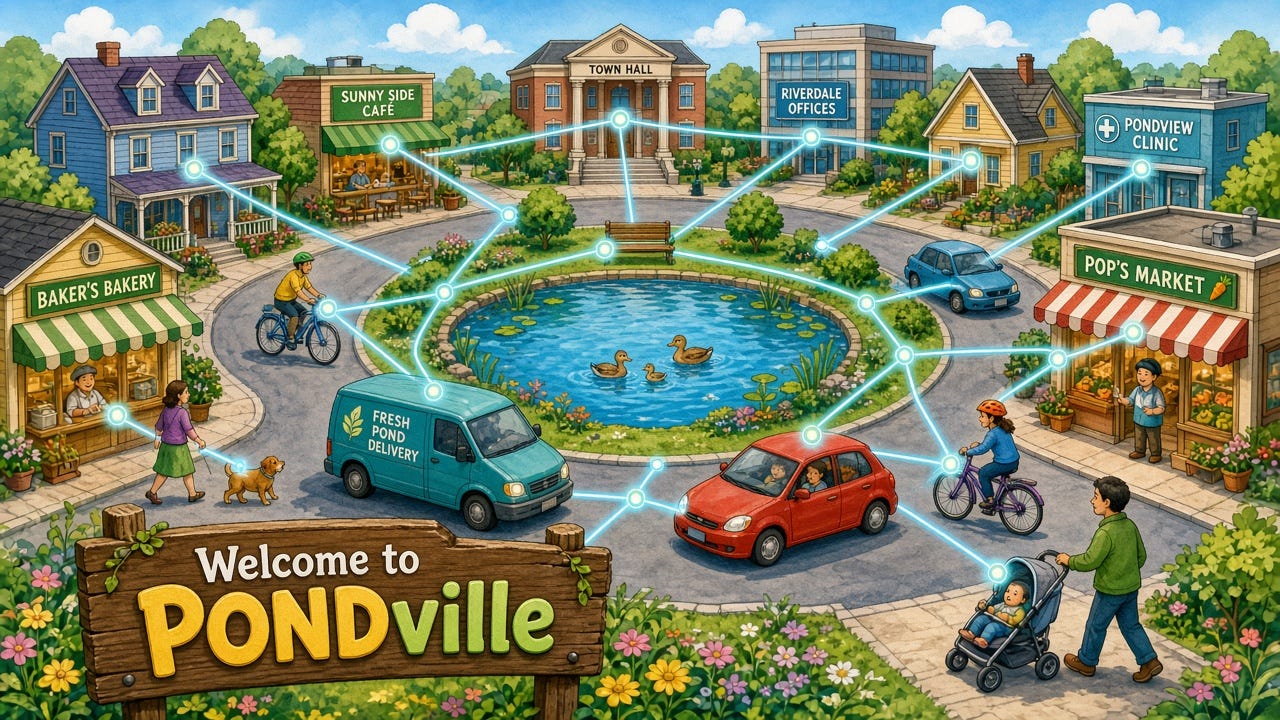
Picture a growing town with a traffic problem. In the vertical version, the mayor and council ship everything to a powerful centralized AI: traffic counts, road maps, budgets, Flock camera feeds, even phone and car location data acquired without asking anyone. Seconds later, the system recommends new lanes and signal changes. The answer might even be useful. But it comes from the top down, it raises real privacy issues, and the residents are completely out of the loop.
In the POND version, the town itself is a distributed intelligence system. Residents, parents, shopkeepers, delivery drivers, cyclists, transit operators and traffic engineers each participate through a personal, private intelligence node. They know things no camera sees: where school pickup bottlenecks every afternoon, which intersection feels dangerous on a bike, when delivery trucks block a key lane, which side street floods in the rain. Each node processes that knowledge locally and shares only what its owner authorizes. Many people choose to share in the public interest, anonymized if they want, and are even rewarded with tax credits. But it’s voluntary.
Across the network, proposals get tested, challenged and revised by the people who’ll live with them. The result takes longer than a centralized answer, but it’s more detailed, and it has the community buy-in that makes it stick. It’s not just an AI-generated traffic plan. It’s a town learning to think together. And nobody in PONDville ever needs to pull a plug, because there’s no third party holding the intelligence. Leaving just means you stop sharing.
Here’s the honest part: we aren’t there yet. People’s instinct to run AI on their own hardware is right, but today we have local models, not local intelligence systems. Drop a small model onto a laptop, ask it to be a frontier-scale brain in a box, and it hits a wall.

That’s the problem we’re working on with Inti by Intelligence Systems, a POND personal node technology. Inti is built from the document layer up to distribute the load across the whole system, so a small local model acts as an intelligence orchestrator rather than a brain in a box. And when many Intis are networked together, they amplify each other. Intelligence emerges from the interaction and exchange of diverse nodes, not from the size of any one of them. Networked personal nodes can become a superintelligence of personal, private, local nodes, without anyone at the top watching.
This is what horizontal, distributed HMI offers: a counterbalance to the vertical model, built on free association and direct sharing between people. It doesn’t need a bureaucracy to keep it honest, because it’s structured so that surveillance and nanny behavior are nearly impossible to begin with. We shouldn’t accept that the only kind of intelligence system worth building is the kind that needs one.
The question isn’t whether AI companies will promise us control. They will, louder and more often as the politics heat up. The question is where the intelligence runs.
Read more about the POND Principle: POND: A Human-Machine Intelligence. Want to build with us? Reach the POND Foundation at foundation@pond.is.