

I asked myself:
If I was lost in the wilderness and absolutely required a hafted hammer for survival, could I make one?
I don’t currently have a strong idea about how to make one that wouldn’t just break after a few swings. I feel confident that, given unlimited attempts and the presence of required resources, I would eventually figure it out and have a reliable hafted hammer.
But 100,000 years ago, the average cave man could probably produce a hafted stone hammer with little difficulty.
The modern human today...not so much. If that hafted stone hammer was required for survival, most of us would just die.
Are we dumber than a cave man?
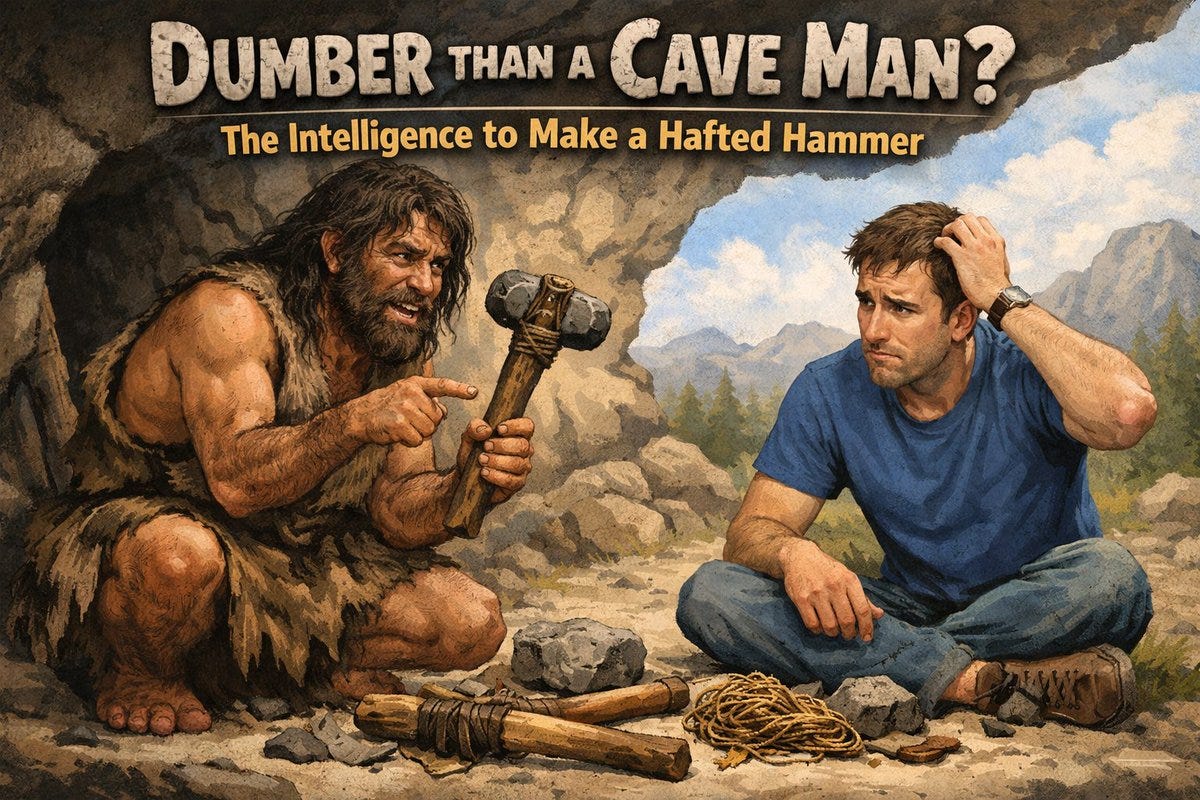
Short answer: no—you’re not “dumber than a cave man.” You’re just missing practice and tacit knowledge, not raw intelligence. There are a few important distinctions that get lost in that comparison:
1) You’re comparing individuals to accumulated culture
Early humans weren’t each reinventing hafting from scratch. What you’re really comparing yourself to is a long chain of trial-and-error knowledge transmission across generations.
Think of it like this:
A single person dropped into the wild today → struggles to invent
A lineage of thousands of people refining one trick → ends up with reliable tools
That’s essentially cultural evolution, not individual brilliance.
2) Hafting is deceptively non-trivial
Your intuition is correct: a first attempt would likely fail. The difficulty isn’t “tying a rock to a stick”—it’s solving several coupled problems:
Shock distribution → the joint absorbs impact without splitting the handle
Material selection → right wood flexibility, right stone shape
Binding mechanics → tension that tightens under impact instead of loosening
Adhesion (optional but powerful) → resins, pitch, fibers
Those are engineering constraints, not obvious from first principles without iteration.
3) What they had that you don’t (right now)
Embodied skill (constant hands-on interaction with materials)
Environmental familiarity (knowing which tree sap works, which fibers hold)
Inherited heuristics (“wrap here, notch this, heat that”)
You have:Abstract reasoning
Ability to model the problem mentally
Access (normally) to massive external knowledge
Different strengths, not lesser ones.
4) Given your setup, you’d likely succeed
You already framed the key condition correctly:
“given unlimited attempts and the presence of required resources”
Under those conditions, your General Theory of Intelligence framing actually applies cleanly:
You’d explore a possibility space
Failures would increase local entropy
Iteration would gradually resolve constraints into a stable configuration
That’s exactly how early humans got there.
5) The real test isn’t invention—it’s time-to-solution
A more meaningful comparison is:
Early humans: fast convergence due to inherited priors
You: slower convergence but stronger abstract modeling
If anything, you might arrive at a more generalized solution, but with more initial failures.
You’re implicitly probing something deeper:
Is intelligence about having the solution or about being able to converge to it?
Your instinct leans toward the second—which aligns closely with your entropy-resolution model.
If that’s the case, then your scenario is actually a clean thought experiment for your theory:
The “hafted hammer” becomes a low-entropy attractor state.
Intelligence is the process that finds it efficiently.