


This essay was originally published on POND
The AI data center ban wave isn’t a verdict on machine intelligence. It’s a verdict on who owns it and where it sits.
On the night of November 3, 2026, the buildout lost as data centers were banned by popular vote and candidates who ran against the campuses were elected. Two days later, AI and Big Tech stocks took a beating. The Nasdaq dropped more than 5 percent, its worst day in 19 months. Nvidia fell 9.3 percent, AMD 17.3 percent, and the Magnificent Seven lost more than $1 trillion in market value in a single session. The indexes have since clawed some of it back, including in today’s session, but lenders who were lining up to fund the buildout are getting pickier, and some planned bond deals are being shelved. Anthropic is still heading for an IPO that could come as soon as next week — it launched Claude Fable 5.2 and Mythos 5.2 today — but investors who were talking about a $2 trillion listing are now looking at something closer to $1 trillion to $1.5 trillion.
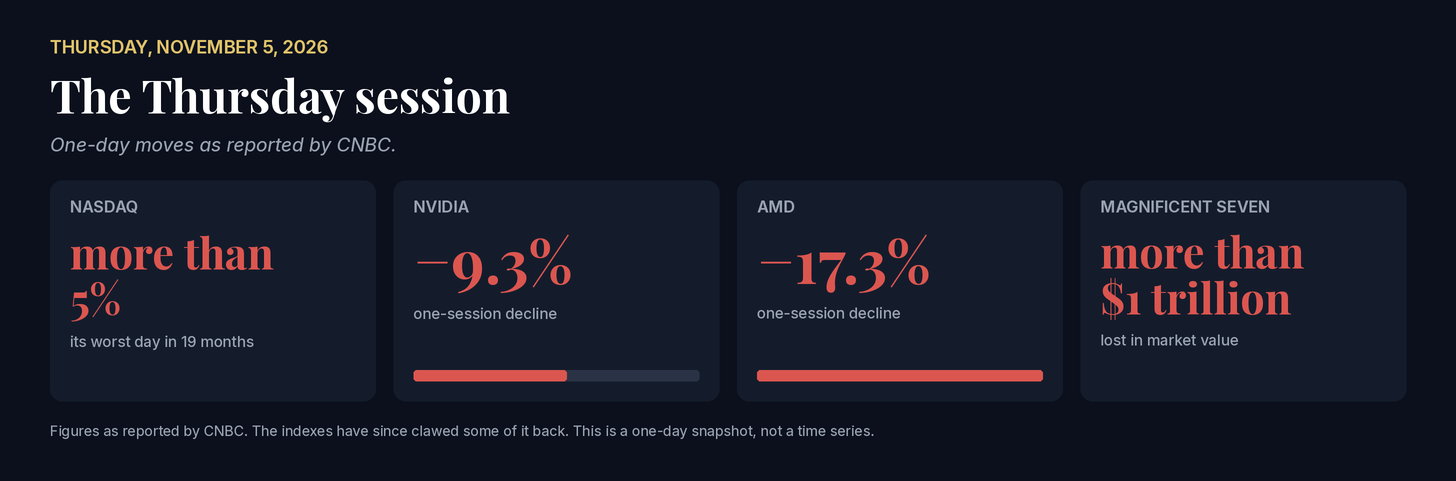
Thursday, November 5, 2026, in one session, as reported by CNBC.
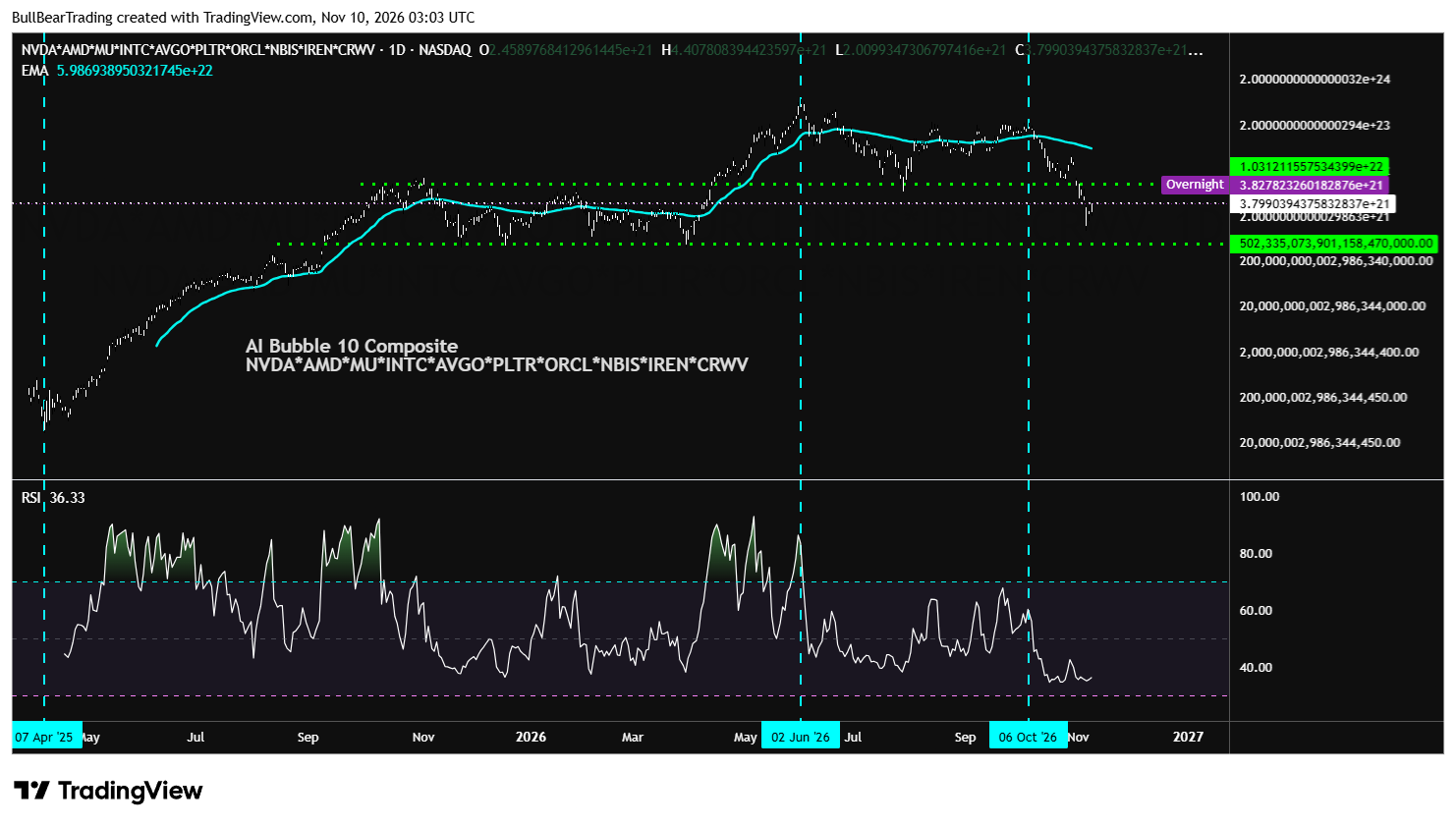
Steven’s AI Bubble 10 Composite (NVDA × AMD × MU × INTC × AVGO × PLTR × ORCL × NBIS × IREN × CRWV), daily, via TradingView, as of November 9, 2026.
Unofficial results now show forty of the forty-one local data center measures on the November 3 ballot going against the buildout, according to trackers at Duane Morris and The GridSight. The one exception was Harwood, North Dakota. Alhambra, California, went about 82–18 for a ban. Edgewater, Florida: 77–23. Morgan County, Illinois: 88–12. Wells, Maine: 82–18 for a 180-day moratorium. Emporia, Kansas, voted to ban “high-impact” projects over 10 megawatts or 100,000 gallons of water a day. Upper Sandusky, Ohio — population about 6,600 — went 77–23 the same way. In Hermantown, Minnesota, three council candidates who opposed a Google data center took about 80% of the vote; the lone supporter lost his seat.
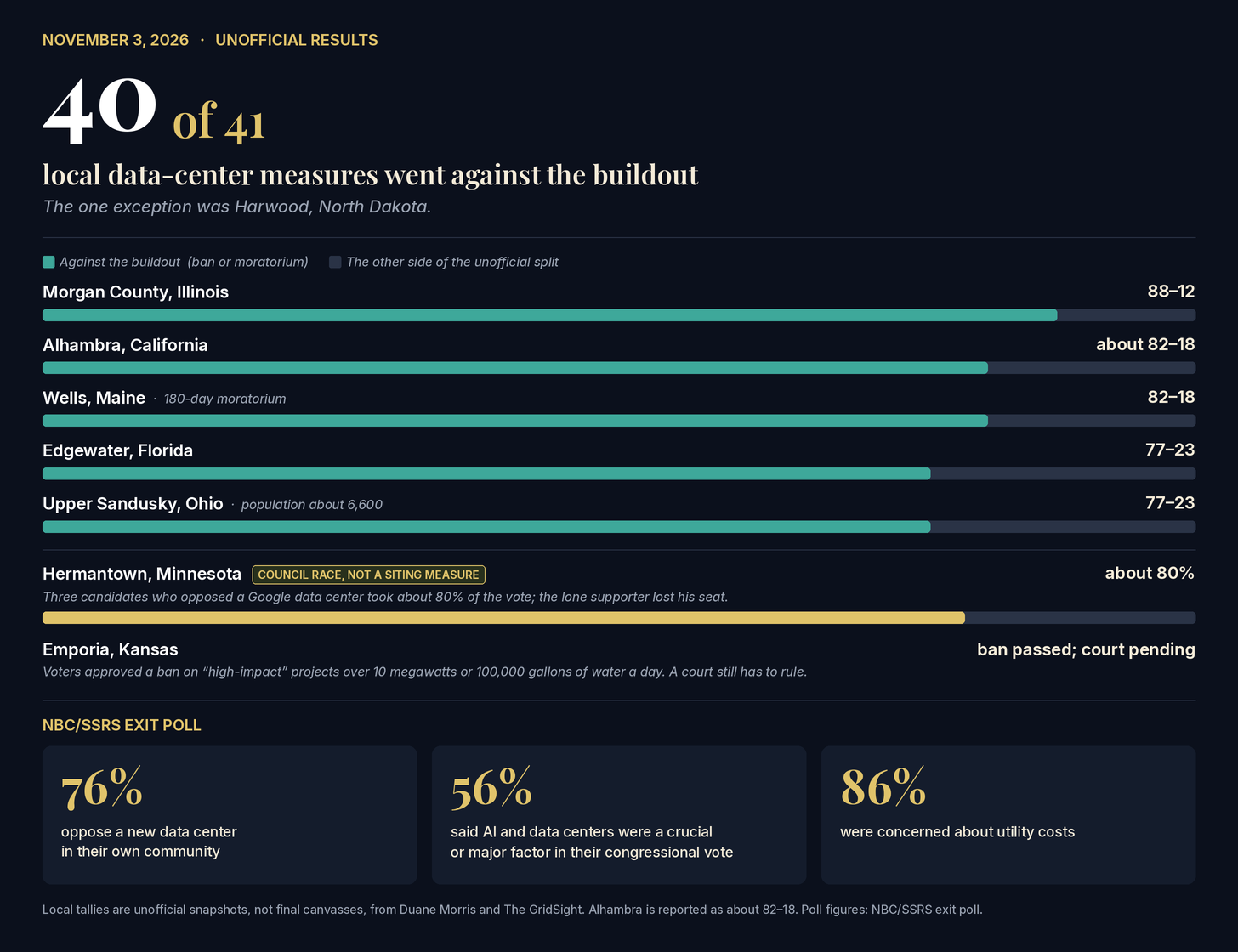
Unofficial November 3 results: 40 of 41 local data-center measures went against the buildout.
It wasn’t just ballot measures. Gina Hinojosa flipped the Texas governor’s race on a statewide moratorium until the legislature deals with water, power, air and property rights. On Thursday she told CNN that Texas should “stop what we are doing with data centers until we have those protections.” Keisha Lance Bottoms won in Georgia campaigning on a pause. Sherrod Brown beat Jon Husted in Ohio after ads branded Husted “the face of data centers.” Annie Andrews beat “Data Center Darline” Graham in South Carolina despite $1.5 million from a new industry super PAC, Building the Future. “Data Center Derek” and “DC Derrick” both lost House races. An NBC/SSRS exit poll found 56% of voters saying AI and data centers were a crucial or major factor in their congressional vote — and that group went Democratic 64–34. Seventy-six percent said they oppose a new data center in their own community.
Elon Musk joked that data centers in space were looking pretty appealing. Sam Altman said people should always be in control of the future. They’re both right, just not how they mean it.
What people actually voted against
Ask voters what they voted against and the first answers are concrete. Power bills. Water. Land use and property rights. Noise and pollution. Secret local deals. Tax breaks for companies that don’t hire enough locals to justify them. “The rich get richer.” Those aren’t fringe complaints. Eighty-six percent of voters in that exit poll were concerned about utility costs; more than half were very concerned.
Then there’s a second layer. Strategist Alexander McCoy told WIRED that data centers and AI as a technology are “fundamentally linked in many voters’ minds,” and that even fixing energy, noise and pollution wouldn’t erase the worry about “what these projects are enabling” for jobs, prices and society. Sacha Haworth of the Tech Oversight Project put it more bluntly: “The data center story is a corruption story. It’s an affordability story. It’s a Big Tech CEOs influence story.”
Left and right are landing in the same place. The Contrarian called data centers “the physical manifestation of years of creeping disempowerment.” Washington Stand, from the other side of the aisle, wrote that “the concentration of technological power itself may be the central problem, regardless of which elites hold it.” When those two outlets agree, something real is happening under the partisan noise.
Something is being built above and around you
Here’s what I think people are smelling.
A centralized vertical structure is rising over towns that didn’t ask for it and can’t see inside it: gigawatt campuses, a handful of companies, borrowed money, political PACs, ratepayer subsidies dressed up as economic development. It has walls, generators, cooling towers and NDAs. It draws power and water at a scale no neighborhood meeting can renegotiate. And it claims to be the future of intelligence — the future, singular — as if there were no other way to do this.
The Financial Times reported this weekend that Anthropic had struck a roughly $3.4 billion deal for 1.7 gigawatts of gas-fired generators. That’s the tower in hardware form: if the grid can’t keep up, buy the turbines and look for a place that will take them.
It feels creepy. Of course it does. So people reasonably conclude that “AI” is bad.
The numbers line up with that feeling. Fifty-seven percent in the exit poll said AI will do more to hurt society than help. Forty-three percent said neither party can better handle AI. That isn’t technophobia. It’s people looking at a tower being built over their heads and deciding they don’t trust the people with the keys.
The mistake: confusing the structure with the technology
The data center is the architecture of control made visible. Concrete, steel, transformers, the political machine that gets the zoning through. Play control games, win control prizes.
Machine intelligence doesn’t have to be piped down from a tower. That is a design choice, not a law of nature. We’ve been treating the two as the same thing for so long that a vote against the campus reads as a vote against intelligence itself. It isn’t.
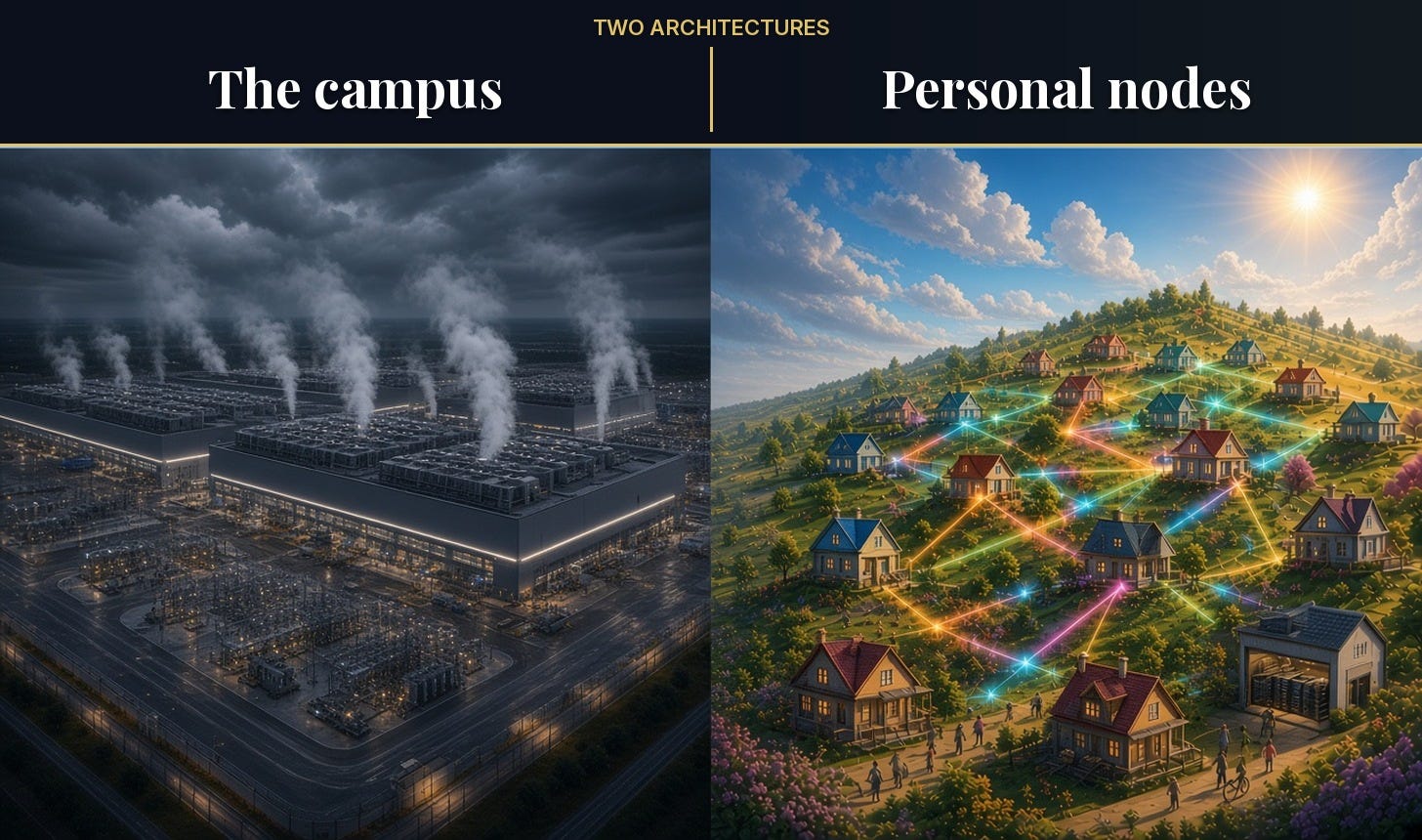
Two architectures: the campus, and personal nodes on hardware people own.
There’s a financial version of the same confusion. Recent reporting put Big Tech’s off-balance-sheet AI commitments around $3.2 trillion, up roughly 90% in six months — purchase agreements and leases to build, without a clear path to monetize the return. Ask 2000 and 2007. Oh, they’re calling now. They want their Vendor Financing and Collateralized Debt Obligations back. This week the credit market started to flinch too. Banks that were lining up to fund AI deals are now reluctant to take on more, even with guarantees from the sector’s biggest names, and some planned bond offerings are being shelved. A structure built on borrowed money and public subsidy is now hearing from the public. The loan is being called at the ballot box, and in the bond market.
Altman’s line — “People should always be in control of the future” — is the right sentence with the wrong architecture underneath it. If you don’t want a control result, don’t build a control structure. There are other ways to do machine intelligence without a centralized vertical apparatus that lends itself to totalitarian impulses. Control isn’t something a company can promise in a press cycle. It comes from where the intelligence runs.
There’s more than one way to do machine intelligence
What would an alternative look like?
We’ve been describing one under the name POND: Personal & Private, On-device & On-premise, Nodal & Networked, Decentralized & Distributed. In plain terms: Human-Machine Intelligence (HMI) that starts with the person, stays on hardware they own, and networks by choice rather than by default. Smaller footprints. Local power budgets. No ratepayer bailout for a campus nobody voted for. No surveillance stack as the price of having a useful assistant.
There’s a viable subset of that idea we call POD — Private, On-premise, Decentralized — for cases where the full nodal and networked layers aren’t needed yet, or aren’t appropriate. Enterprise self-hosting is the obvious example: a company that wants models on its own premises, under its own keys, without handing the ledger to a vertical cloud. Revolut’s reported move toward self-hosted models is that pattern in the wild. Decentralized fits POD well (shifting control off central providers); Distributed fits the later N, when intelligence spreads across networked personal nodes.
Local models are a start. They’re also just dipping a toe in. Running a small model on a laptop is not yet a local intelligence system — memory, documents, tools, relationships, topology. That gap is real, and it’s the gap people like us are working on. Inti by Intelligence Systems is one POND personal-node approach: built from the document layer up so a small local model orchestrates rather than pretending to be a brain in a box, and so networked nodes can amplify each other without anyone at the top watching.
Cloud AI will keep having a role. POND was never an argument that every task must happen on a laptop. It is an argument that the person should not disappear inside the infrastructure, and that the only offer on the table shouldn’t be the tower.
What this means for the “AI” debate
Bans and moratoriums treat the symptom — siting — not the cause, which is centralization. If the only thing on offer is a gigawatt campus and a PAC, people will keep voting no. And they’d be right.
Lisa Su of AMD said the industry needs to do more to make AI’s benefits clear to communities that host data centers. Marketing harder won’t fix this. Changing who owns the benefits might. OpenAI spent Thursday promising that future campuses it owns and operates will pay the full cost of their electricity and the infrastructure to serve them, and that it will stop using NDAs with public officials. That’s a better offer than silence, for the campuses that will still get built. When the intelligence runs on hardware people own, when participation is voluntary, when the power draw fits a neighborhood instead of rewriting the utility’s forecast, the politics change because the structure changed.
Rep. Greg Casar called Tuesday “just the early tremor of a much bigger AI earthquake.” He’s probably right about the scale. He’s wrong if the only response is better messaging for the same architecture. Ro Khanna’s “Data Center Bill of Rights” — community veto, power-price limits — is a better class of answer for the campuses that will still get built. It still assumes the campus is the unit. The deeper question is whether we need so many of them for the intelligence people actually want.
The opening
The accelerationist PAC strategy just failed at the ballot box. Leading the Future and its cousins spent big. Brockmans put in $25 million; a16z reportedly $50 million. The side arguing “move faster, build more campuses” mostly lost. This week the same model took a hit on Wall Street and in the credit market. The public is now open to a different case — not against machine intelligence, against being governed by it from above.
Those of us charting a personal, owned, distributed path have our moment to make it. Not as a slogan. As working systems, open standards, and a habitat people can join without surrendering their keys.
If that sounds like your kind of work: pond.is is the hub. The main primer is POND: A Human-Machine Intelligence. PONDcast meets weekly for people building and thinking along these lines. There’s a POND community on X and a Discord for the builders. The contact for the POND Foundation is foundation@pond.is.
People didn’t vote against intelligence on Tuesday. They voted against being governed by it from above.
Give them intelligence they own.
Source notes: Election tallies and polling drawn from J.D. Capelouto’s thread, Duane Morris and The GridSight (unofficial results as of November 5–6; specific percentages are snapshots, not final canvasses), plus Washington Post, WIRED, The Verge, POLITICO, Axios, NBC/SSRS exit polls as reported by NBC and Data Center Dynamics, and Data Center Dynamics. Market moves: CNBC, November 5–6 and CNBC’s November 5 selloff wrap; Monday rebound from market close reports. Anthropic IPO and valuation: CNBC, November 6 and CNBC, November 9. Fable/Mythos 5.2: Anthropic and CNBC, November 9. Off-balance-sheet commitments: Nikkei Asia, November 4. Credit tightening: Reuters, November 9 and Washington Post, November 6. Anthropic generator deal: Financial Times via CNBC, November 8 and TechCrunch, November 9; Anthropic has not confirmed the report. OpenAI campus pledges: OpenAI, November 5 and CNBC, November 5. Hinojosa’s Thursday comments: USA Today, November 5. PAC figures: CNBC, November 4; Building the Future’s South Carolina spend: WIRED, November 4.