

What happens when the most important question about AI/SI is no longer whose model wins this week’s benchmark?
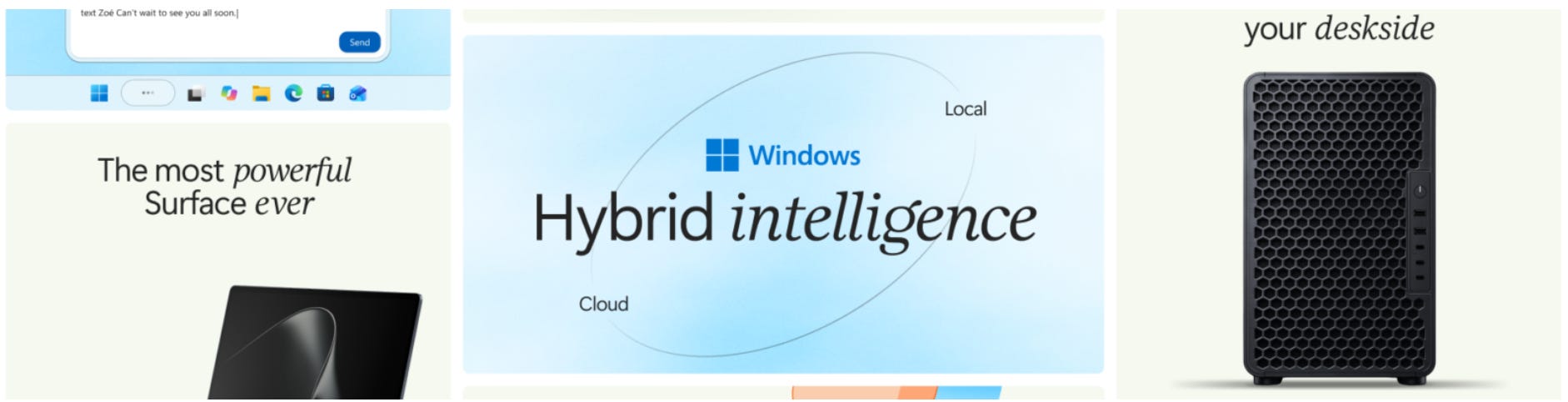
Microsoft’s October 7 announcement offers a glimpse. Under the banner of “hybrid intelligence,” the company is building Windows around AI that can work locally, reach the cloud when needed, and operate within defined boundaries. Copilot is slated to gain access—with permission—to local context, local actions and local models. Those Copilot capabilities are expected to begin rolling out over the coming months. Windows Blog
My reading: the personal computer is being repositioned as something more than a terminal for intelligence rented from somewhere else.
That is a direction I have been anticipating—and building toward. I call the broader vision the POND Principle.
The contest behind the contest
I’ve been arguing that companies like Apple, Microsoft and Google are positioning themselves for the phase beyond the Model Wars. Not necessarily sitting out the competition, but preparing for a future in which having the best model is no longer the whole game.
You don’t have to win the model wars to win the computing era they make possible.
Apple’s June developer announcement pointed in this direction: a framework spanning on-device models, server models and third-party providers, alongside new tools for running custom models locally. Google’s Gemini Nano similarly brings on-device AI into Android through its AICore service. Different approaches, but both make machine intelligence part of the computing environment rather than only a destination you visit online. Apple
Microsoft is now widening that opening. Its new experimental Windows ML capabilities make it easier for developers to run models of their choosing locally, including through open-source tools. This is infrastructure that independent applications can use—not just another feature inside Microsoft’s own assistant. Microsoft Developer Blogs
There is a practical reason for the shift. Microsoft explicitly says customers’ AI needs are outgrowing their cloud budgets. Moving suitable work onto personal hardware is part of its answer. Windows Blog
Models still matter. But I expect the center of gravity to move toward what surrounds them: personal knowledge, useful applications, trusted relationships and meaningful control.
Which brings us to POND.
What is POND?
POND is a set of principles for the intelligence ecosystem we should be building: Personal & Private, On-device & On-premise, Nodal & Networked, Distributed & Decentralized. POND Discussion
Personal & Private. Start with the person. Your documents, interests, memories and working context should serve your purposes, under boundaries you understand and control. Personalization should not require surrendering your personal life.
On-device & On-premise. Put capability close to the people using it—on their computers, phones or infrastructure they control. Use remote services when useful and authorized, rather than making dependence on them the starting assumption.
Nodal & Networked. Personal does not mean isolated. Each person’s intelligence environment can become a node: a place from which they connect, collaborate and contribute. Share what is useful without automatically sharing everything that is private.
Distributed & Decentralized. Spread both capability and control. Distributing computation across many devices is useful; ensuring that one provider does not control everyone’s participation is a further, distinct goal.
POND is not an argument that every task must happen on a laptop. It is an argument that the person should not disappear inside the infrastructure.
The cloud can be a resource without becoming the landlord of your digital life.
Local is not the same as yours
This is where we should welcome Microsoft’s direction without confusing it with the destination.
There are substantive building blocks here. Microsoft Execution Containers can enforce boundaries on which files and networks an agent can access. GitHub Copilot is adding both automatic local/cloud routing and explicit local-model selection. Those are meaningful mechanisms for choice and control. Windows Blog
But Microsoft’s technical explanation also makes an important distinction: “local inference does not make the session offline.” Running the model on your machine does not settle what the rest of the application communicates or depends upon. Command Line
So the questions go further. Can you change models without losing your accumulated knowledge? Can you move to another application? Can you decide what leaves your device? Can you participate in a network without handing the network your entire personal history?
These are the tests I would apply to a POND-aligned product.
A locally running model is a component. A genuinely personal intelligence environment requires more.
Not a replacement for you. An extension of your agency.
The deeper shift is not from a giant AI in a data center to a smaller AI in your laptop.
It is from treating intelligence as something delivered to passive consumers to building Intelligence Systems: systems through which people become more capable of understanding, creating and acting together.
My starting point is the existing human world of language, knowledge, relationships and shared endeavor. Machine intelligence should strengthen that world—not turn people into spectators watching autonomous systems do everything.
Imagine researchers retaining their private working libraries while exchanging selected, source-backed findings. Or a community developing a proposal through contributions from people with different experiences, with machine assistance helping them compare evidence, identify disagreements and refine the result.
The objective is not one enormous chatbot spread across a million devices. It is a million people better equipped to participate.
That is the POND ambition: personal agency and collective capability growing together, rather than one being sacrificed for the other. POND Discussion
Building toward that future
This is the direction of our work on Inti and Intellipedia, beginning with Inti Reader and the personal Library.
We are developing IntiDocs as structured, source-grounded documents that people can read and machines can work with precisely. The aim is to give personal intelligence a dependable knowledge foundation—not simply attach another chatbot to a pile of files. INTI_READER_PRODUCT_VALUE_PROPO… INTI_READER_PRODUCT_VALUE_PROPO…
But POND is bigger than our products. It names an ecosystem we want to help cultivate, not a territory we claim to own. Independent developers, communities, researchers—and major technology companies—can all contribute. POND Discussion
That is why I see Microsoft’s announcement as an opening, not merely a competitive threat. Better foundations for local intelligence could enable far more than the platform company itself chooses to build.
The Model Wars ask: Who can build the most capable model?
POND asks: How do we make people more capable—and keep them in control?
The first question matters. The second is the future worth building.
Jump into the POND!
POND X-Community
https://x.com/i/communities/1695429836993712389
POND X-List:
https://x.com/i/lists/2065974648450453803
Reddit: r/PONDAI
https://www.reddit.com/r/PONDAI/