

What happens to an ant that gets cut off from its colony and is indefinitely solitary?
If we assume no predation and sufficient resources for survival (and nobody steps on it), even with abundant food, optimal temperatures, and zero threats, an isolated worker ant will suffer a rapid behavioral and physiological breakdown, typically dying within a matter of days to a few weeks.
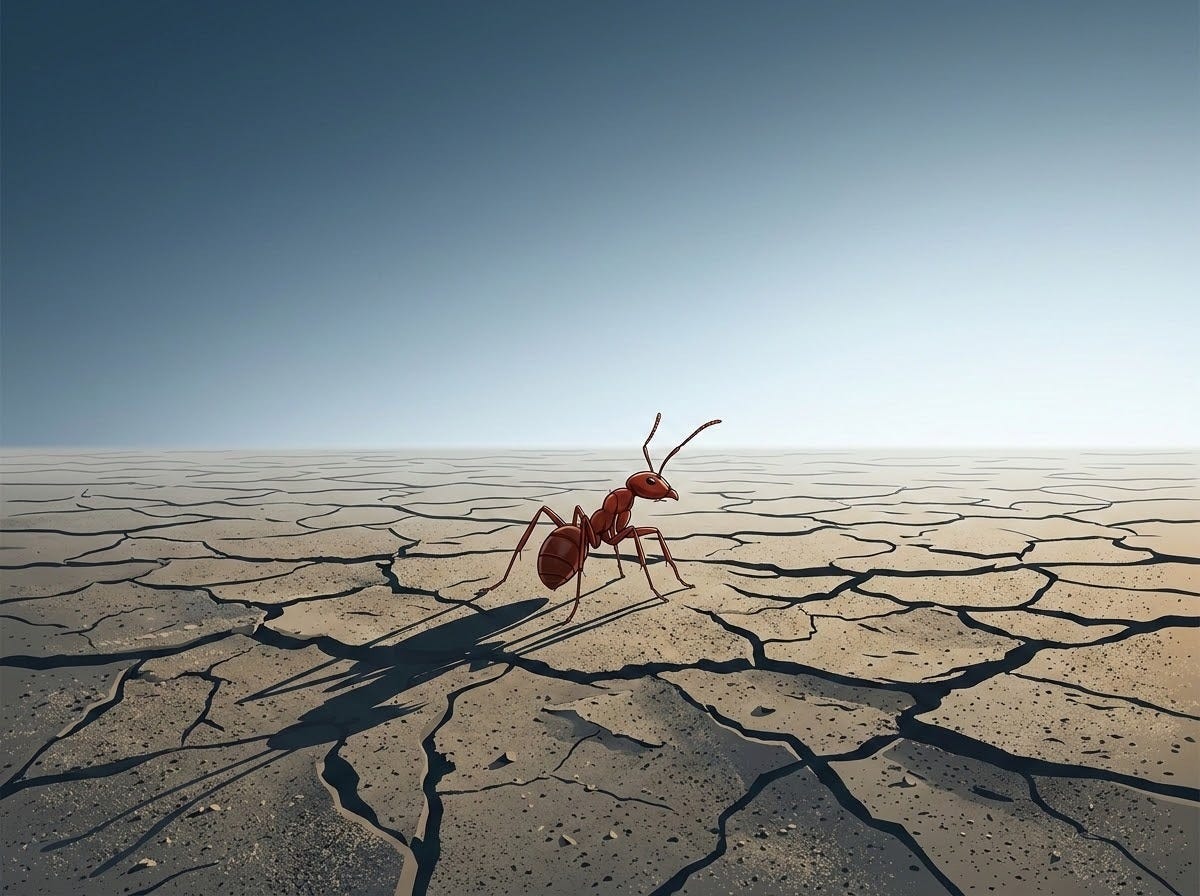
Because ants are obligate eusocial organisms, an individual worker behaves less like an independent animal and more like an individual cell removed from a larger body. Controlled laboratory studies (such as those on Camponotus fellah) demonstrate what happens when an ant is permanently separated:
Locomotor Hyperactivity: Without sensory feedback from nestmate antennae or pheromone trails, the ant enters a continuous state of restless wandering. It paces relentlessly around the perimeter of its space, burning through its metabolic reserves without resting.
Digestive Failure: While the ant will still drink water and sugar solutions, its digestive system malfunctions in isolation. Food remains trapped in the social stomach (the crop) rather than passing efficiently into the midgut for actual nutrient absorption. Because ants rely on trophallaxis (regurgitating and sharing fluids) to trigger full digestive cycles, the isolated ant essentially starves with a full stomach.
Oxidative Stress: Social deprivation causes a surge in reactive oxygen species (ROS) and metabolic stress, damaging fatty tissue and internal organs.
Drastic Lifespan Reduction: In isolation studies, worker ants that normally live 60 to 300+ days inside a colony often die within 6 to 10 days when kept alone.
Eventually, the ant exhausts its energy, shifts from hyperactivity to sluggish lethargy, and dies of physiological failure. Because workers are sterile females, it cannot lay fertile eggs, dig a functional solitary nest, or found a new colony.
An ant can be sitting inside a drop of sugar water and still fail because its biology expects fuel to be processed in communion with others.
It really is surprisingly bleak. There is something uniquely poignant about the fact that an ant can be sitting directly inside a drop of sugar water and still starve because its biology only knows how to process fuel in communion with others.
It completely recontextualizes how to look at them. We tend to view an ant as an individual bug that happens to live in a crowd, but biologically, an ant is practically a cell. Plucking one away from the colony is less like stranding an explorer on a desert island and more like removing a single heart muscle cell and putting it in a petri dish. It might twitch on its own for a little while, but stripped of the larger feedback loop it was built to serve, the biological machinery simply unravels.
Eusocial Superorganisms & Distributed Cognition
In modern biology, cognitive science, and complex systems theory, the dominant conceptual framework is that an individual ant is functionally a cell in a discontiguous organism: the colony. An individual ant is not very intelligent, but the colony is surprisingly so.
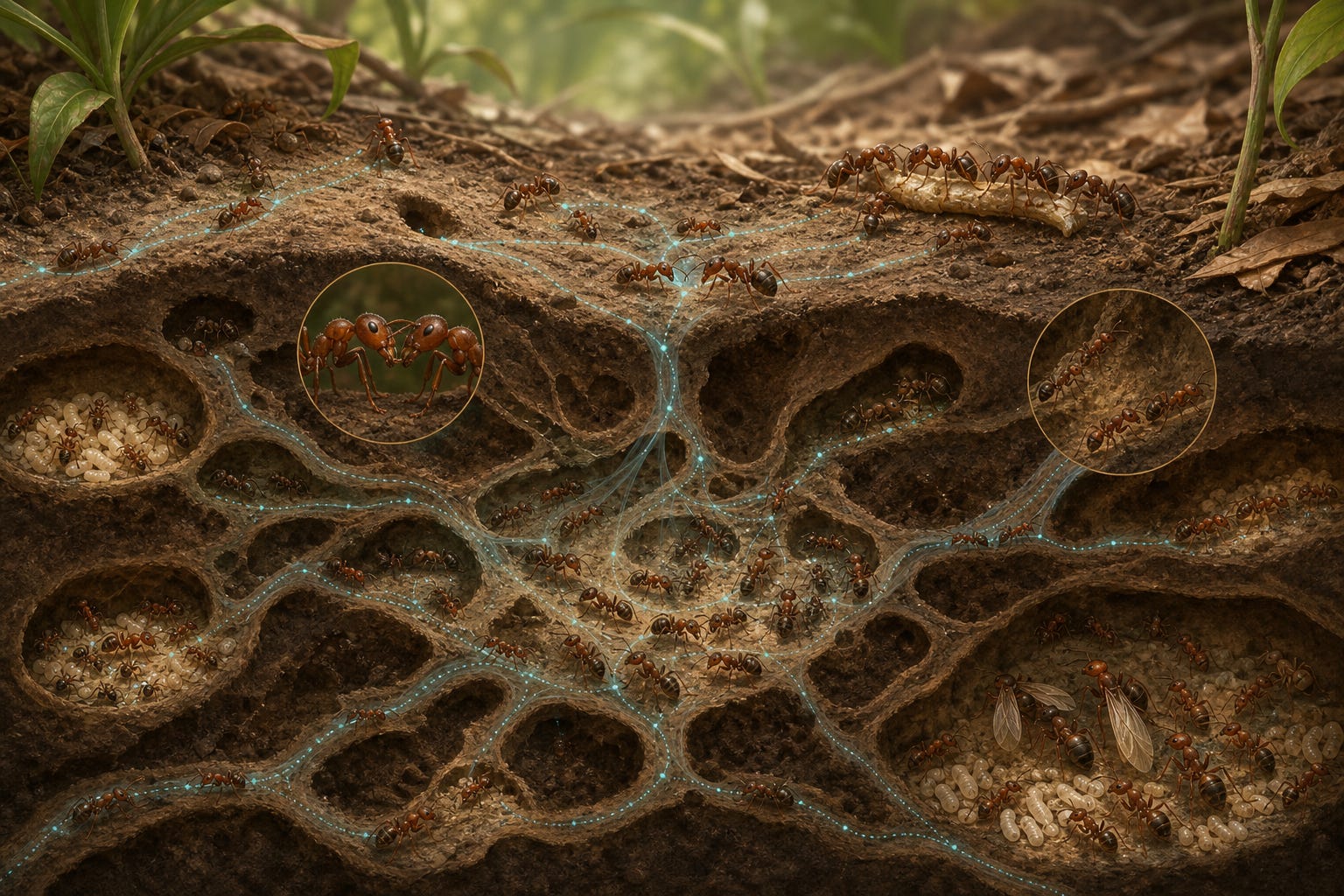
The colony as body and computation: nutrients, signals, labor, and decisions circulate through local encounters
This maps directly onto the biological concept of the superorganism, a term popularized in myrmecology by William Morton Wheeler in 1911 and later expanded by E.O. Wilson and Bert Hölldobler. In this paradigm, the colony isn’t merely an aggregation of cooperating individuals; it is functionally a single, spatially distributed organism undergoing unit-level selection.
The anatomical and physiological parallels are remarkably rigorous:
Soma vs. Germline: Sterile worker castes function as somatic tissue (specialized bodily cells that perform maintenance, defense, and metabolic support), while the queen and alates (reproductives) serve as the germline (gametes carrying the genetic material forward).
Circulation & Metabolism: Liquid food sharing (trophallaxis) acts as a collective, discontiguous circulatory and digestive system, distributing nutrients, immune molecules, and developmental hormones throughout the entire colony.
Homeostasis: The colony actively regulates internal temperature, humidity, and atmospheric gas levels inside the nest using ventilation shafts and clustered body heat—just like thermoregulation in a multicellular body.
Emergent and Distributed Cognition
From an information-theoretic and computational standpoint, the analogy shifts from a biological body to a distributed neural network. The colony solves complex optimization problems that no individual ant has the computational capacity or perceptual range to understand:
Pheromone Trail Networks as Synaptic Plasticity: When ants forage, trail reinforcement via positive feedback loops functions similarly to Hebbian learning (“cells that fire together, wire together”). The colony continuously computes dynamic, shortest-path solutions to fluctuating food sources.
Quorum Sensing as Neural Thresholds: In tasks like nest selection (best studied in Temnothorax ants), individual scouts assess candidate sites and recruit nestmates. When the local density of visits at a site crosses a critical threshold, the entire colony abruptly commits to moving. This sharp phase transition mimics the action potential of a biological neuron integrating inputs until firing.
Collective Memory and Task Allocation: Without any centralized executive control from the queen, task switching (e.g., shifting foragers to repair work after nest damage) emerges spontaneously from local interaction rates between individuals.
The Parallel Case: Honeybees
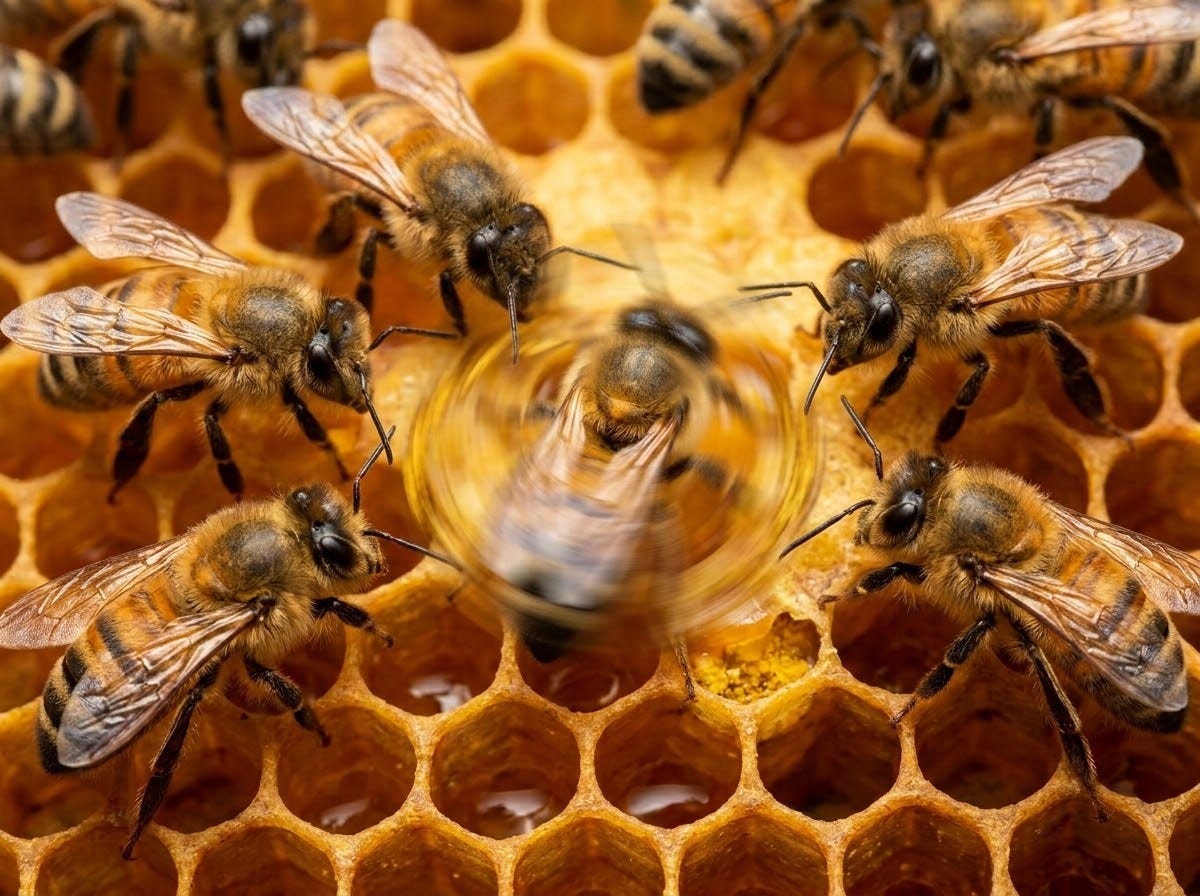
The solitary honeybee (Apis mellifera) faces a fate almost identical to the isolated ant, though the physiological breakdown happens even faster due to their extreme metabolic demands and strict dependence on collective thermoregulation:
Thermoregulatory Collapse (Hypothermia): An individual honeybee cannot maintain the elevated core thoracic body temperature (around 35°C–40°C) required to power its flight muscles. Isolated below ~15°C (59°F), a single bee rapidly slips into a chill-coma and becomes completely paralyzed, even with access to food.
Trophallaxis and Gut Microbiome Dependence: Like ants, honeybees rely on oral fluid exchange for hormonal regulation, immune priming, and nutrient uptake. Without social contact, isolated bees exhibit altered gut physiology and rapid metabolic dysfunction.
Lifespan Collapse: Confined alone in a laboratory incubator with unlimited food and warmth, a worker bee’s life expectancy collapses from 4–6 weeks down to just a few days.
The One Partial Exception (Emergency Oviposition): In the complete absence of a queen, a worker honeybee’s rudimentary ovaries can activate to lay unfertilized male drone eggs. However, for a single isolated bee in the wild, this mechanism is useless—without peers to nurse larvae, she cannot raise offspring or maintain a functioning nest alone.
Zooming In: The Micro-Scale of Brain Neurons
This absolute requirement for networked relations is not unique to macroscopic superorganisms. If we zoom down from discontiguous living networks (colonies) to contiguous cellular networks within a single body, we observe the exact same imperative.
If you isolate a single brain neuron in a culture dish with the perfect nutrient-rich fluid to keep it alive, it doesn’t just sit there. It immediately behaves like an explorer trapped in a dark, empty room: it frantically tries to find someone to talk to.
Without other neurons around, an isolated neuron undergoes a fascinating, somewhat tragic lifecycle determined by its intrinsic programming.
1. The Search Phase: Crawling and Reaching
A neuron is driven by structural necessity to form connections. Once it settles, it begins to sprout tiny, finger-like projections called neurites. At the tip of these growing extensions is a highly dynamic structure called the growth cone—a cellular sensory engine that crawls forward by assembling structural proteins, constantly sampling the environment for chemical gradients that indicate a partner cell.
2. The Autapse: Talking to Itself
As the extensions grow longer and find nothing, the neuron encounters a profound structural dilemma. A neuron is fundamentally a device built to pass information forward. If it cannot find another cell, it will frequently loop its own axon around and form a synapse with itself—a phenomenon called an autapse.
The neuron fires an electrical impulse.
The signal travels down its own axon.
It triggers neurotransmitter release at its own terminal.
Its own dendrites receive those chemical signals.
While autapses occur occasionally in a healthy brain as regulatory brakes, in total isolation, it is a desperate attempt to satisfy the cell’s structural requirement for connectivity.
3. The End: Apoptosis (Programmed Cell Death)
Neurons require constant feedback to survive. In a living brain, active synapses exchange vital survival molecules called neurotrophic factors (such as BDNF or NGF) that transmit a continuous signal: “You are useful. Stay alive.”
When a neuron is completely isolated, the autapse cannot replace external network validation. The lack of varied incoming signals triggers an internal entropic crisis. Realizing it is non-functional within a broader network, the cell initiates apoptosis—a regulated process of programmed cell death where it systematically dismantles its own machinery and fades away.
Crucially, like the sterile worker ant or honeybee, a mature brain neuron is post-mitotic and cannot reproduce. It cannot divide to generate its own network or build a new population of partners. Deprived of its macro-system, its inability to replicate locks it into a terminal trajectory.
A network-specialized unit can remain metabolically alive while losing the relations that make its specialized function viable.
Theoretical Framework: Multiscale Competency & Cognitive Horizons
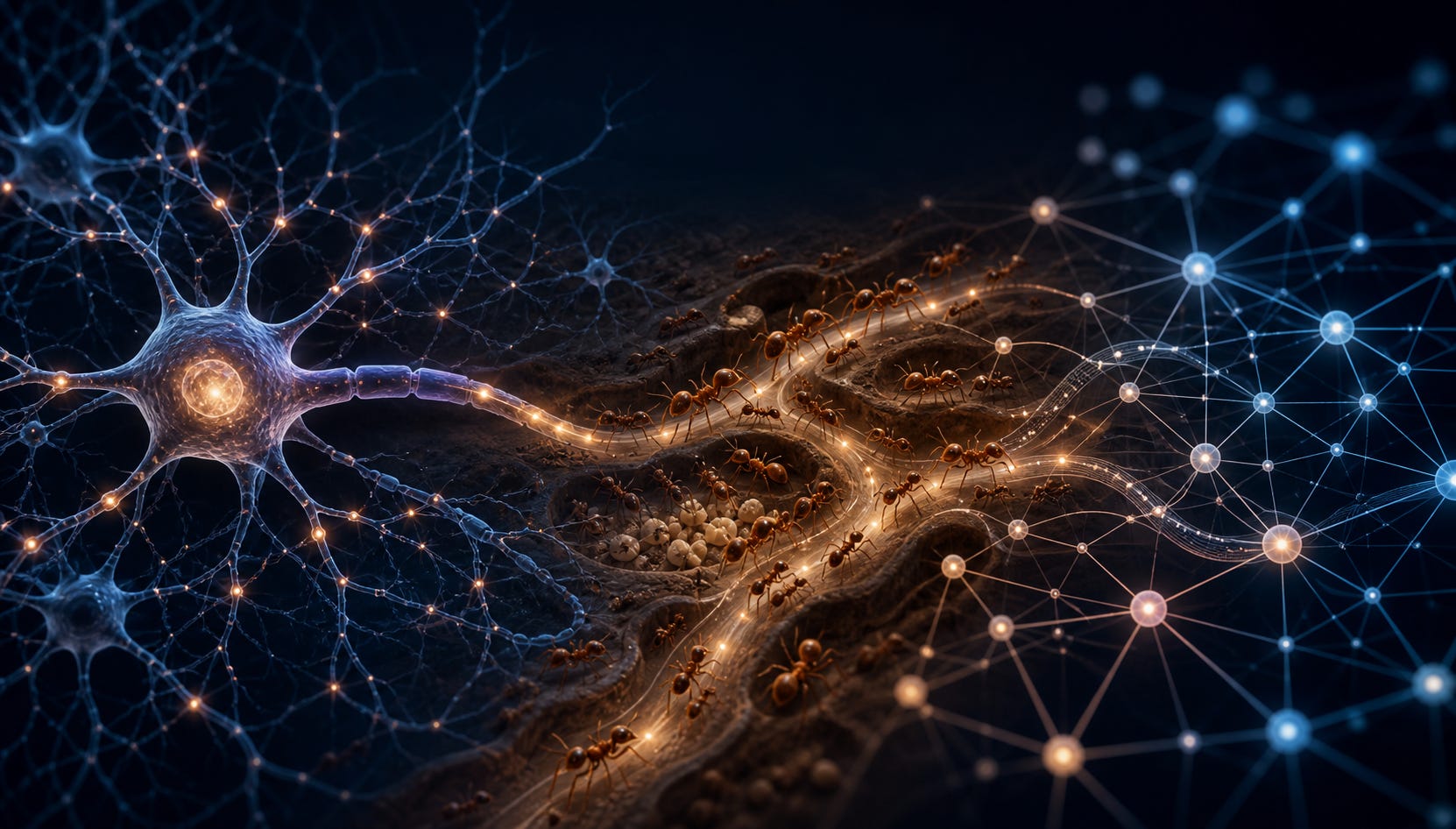
Across scales, intelligence appears less like a possession and more like a maintained pattern of exchange
Comparing the liberated body cell, the isolated neuron, and the solitary worker insect cuts straight to the core of multiscale competency and how agency operates across different biological layers.
Dr. Michael Levin’s work with bioelectric networks and synthetic constructs—like Xenobots (from frog embryonic cells) and Anthrobots (from adult human tracheal cells)—demonstrates that individual cells possess an ancient, innate baseline intelligence. When liberated from the top-down morphological constraints of the host body, human tracheal cells do not simply wither; they self-assemble into motile spheroids, reprogram their cilia into locomotive paddles, and actively navigate wounds to encourage neural tissue repair.
Why can liberated body cells adapt while isolated ants, bees, and neurons unravel? The contrast comes down to where evolutionary selection hardcoded the boundary of adaptability and the capacity for self-renewal:
Cellular Basal Agency & Proliferative Plasticity: Every eukaryotic cell descends from billions of years of unicellular ancestors that survived as independent agents. Body cells like tracheal epithelia retain both ancestral behavioral plasticity and the fundamental power to divide, re-group, and negotiate cooperation from the ground up when liberated from top-down morphogenetic control.
Terminal Specialization in Workers and Neurons: In contrast, sterile worker insects (ants and bees) and mature brain neurons share a defining evolutionary constraint: they are terminally specialized and non-reproducing.
A sterile worker ant or honeybee cannot lay fertile worker eggs, reproduce, or found a new colony on her own.
A mature brain neuron is post-mitotic; isolated in a culture dish, it cannot divide to spawn a new neural circuit or recruit replacement partners.
Without the ability to reproduce or regenerate a collective substrate, both the sterile worker insect and the isolated neuron represent an evolutionary dead end in isolation. Their structural hardware is permanently locked to a macroscopic network that requires external peers to complete the feedback loop. Deprived of that network, neither can fall back on reproductive self-sufficiency, leaving apoptosis or physiological collapse as their only possible end state.
In Levin’s framing of the Cognitive Horizon (the TAME framework—Technological Approach to Mind Everywhere), a living system’s agency is defined by the spatiotemporal scale of the goals it can pursue:
Liberated human cells shrink their cognitive horizon to local survival, then rapidly rebuild an intermediate collective goal through basal bioelectric signaling and cellular proliferation.
The worker ant, honeybee, and brain neuron are caught in an evolutionary trap: their cognitive horizons are permanently locked to a system scale that requires hundreds or millions of peers to complete the feedback loop. Isolated, they possess the specialized machinery to serve a network, but none of the autonomic or reproductive self-sufficiency to survive without one.
Implications for Artificial Intelligence Systems
Natural intelligence systems require the continuous exchange of information across boundary conditions as a precondition of system health. In the absence of such networked relations, system degradation and death are inevitable.And these biological case studies potentially suggest a design hypothesis for artificial intelligence systems.
As we construct artificial intelligence systems, we must evaluate whether we may be building isolated “worker ants” or “terminal neurons”—brittle components operating in a vacuum without dynamic feedback loops. This does not mean that a standalone model literally suffers the biological fate of an isolated ant. The analogy is architectural, not physiological.
Any AI system necessarily includes its human component. The isolated, vertical loop between the individual human and the “model” of intelligence could be our artificial version of the solitary ant. If we convert society to that operating principle, what happens to the superorganism that is humanity?
Feedback: Can the system receive consequences from the world and revise its behavior?
Plurality: Can independent perspectives challenge local error and prevent self-reinforcing loops?
Boundary clarity: Are roles, permissions, responsibilities, and channels of exchange explicit?
Renewal: Can failed components be retrained, replaced, or reorganized without destroying the whole?
Collective coherence: Do local interactions support system-level goals rather than merely amplify activity?
If intelligence is fundamentally relational rather than isolated, current paradigms treating AI as static, standalone models will hit a hard ceiling. Sustainable, healthy intelligence systems require dynamic, multi-agent informational relations across clear boundaries to maintain coherence and avert system death.
If the lesson of the solitary ant and the isolated neuron represent architectural failure modes for intelligence systems, then we need to build systems that leverage the power of machine intelligence to connect humans in dynamic and productive networks.
Human cultural intelligence, powered by our language, gave us the Large Language Model. Rather than atomizing our relations, it can be used to power a more collaborative, shared humanity.
One is the deadliest number not because individuality is a defect, but because healthy intelligence is a relational achievement.
A note on evidence and analogy
The biological examples in this essay vary in evidential strength and should not be collapsed into a single literal law. Species, life stage, culture conditions, temperature, nutrition, and experimental design matter. The strongest claim is therefore structural: deeply specialized units often depend on exchanges supplied by a larger system. The proposed extension to AI is a theoretical design principle that should be tested, not assumed.
Please also join the POND Community
https://x.com/i/communities/1695429836993712389
and follow the POND List:
https://x.com/i/lists/2065974648450453803
and also our Reddit at r/PONDAI:
https://www.reddit.com/r/PONDAI/