

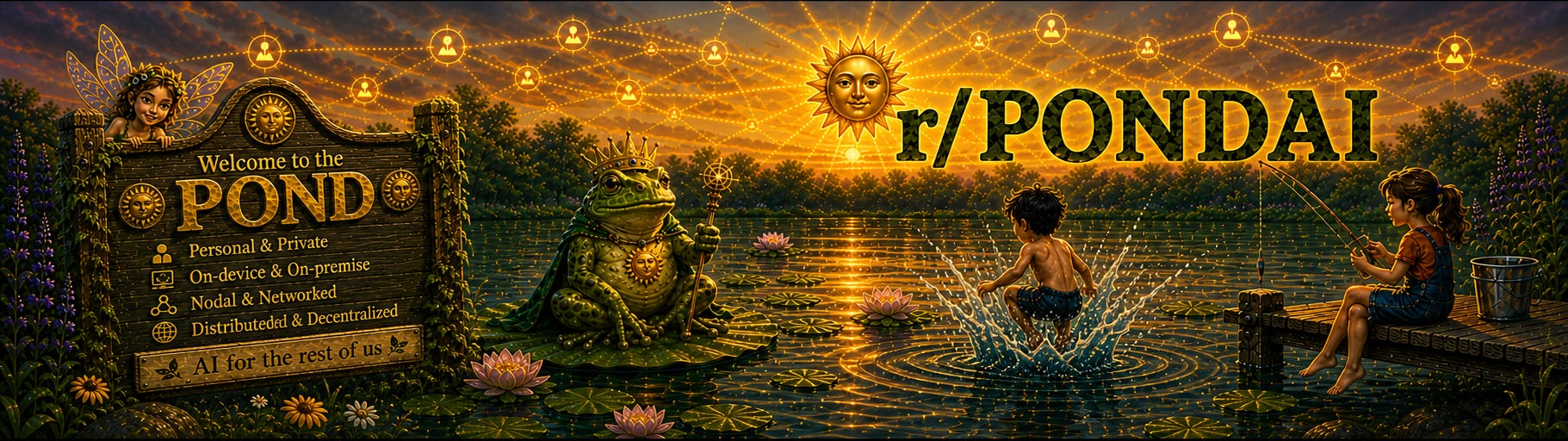
For a Human-AI intelligence system that is:
Personal & Private
On-Device & On-Premise
Nodal & Networked
Decentralized & Distributed
r/PONDAI is the community for thinkers, designers, builders and all people who support a personal, private, participatory future of distributed and decentralized Human-AI intelligence.
Humanity is at the start of a vast expansion of its intelligence capabilities. Large Language Models (LLM’s) represent a powerful and useful first step. These initial Artificial Intelligence systems can be very helpful, engaging and entertaining.
But there are some very serious issues with the system that is being built around them.
Currently, AI is being developed as a vertical, centralized structure: ever larger AI models in always bigger data centers owned by a small number of companies. Individual users pump their information and thoughts into the machine to get back answers and some useful agentic functionality.
That structure presents the real danger of an extreme centralized concentration of power and control by a technocratic elite. If we don’t think this through thoroughly, the dystopian visions warned about in Sci-Fi can easily become our living reality.
Centralized “cloud” AI will likely have an important role in any future global intelligence system. But it cannot be the only component.
An intelligence system that produces the best results in service to the interests and the benefit of all humanity will need offsets, just as a good political constitution needs checks and balances to prevent a concentration of power. It will need a counterbalancing component that is distributed horizontally, connecting all people in a free-flowing network of cooperative intelligence.
The POND Principle proposes the shape of an alternative and a necessary counterbalance to centralized structures.
What is POND?
POND stands for:
Personal and Private
On-Device and On-Premise
Nodal and Networked
Decentralized and Distributed
The POND is not one company, platform, protocol, or product. It is an emerging ecosystem of people, devices, models, companies, organizations and communities which together form intelligence systems that are based locally, connect voluntarily, and participate in larger networks without surrendering private data, identity, agency, and value to any centralized authority.
The health of a natural ecosystem, such as a pond, relies upon the interaction of all its denizens and elements: sun, water, bacteria, fish, plant life, insects, frogs...too many components to even list.
Like a natural pond, a POND intelligence system will evolve as a living ecology: many participants, human and AI alike, exchanging information, forming relationships, adapting, and creating real value and new knowledge together.
PONDVILLE
Imagine Pondville, a thriving, growing town. It’s roads are becoming increasingly congested and a solution is needed.
Before adopting the POND Principle, the town was managed with a vertically centralized model.
To tackle the traffic issue, the mayor and city council would have shipped the town’s data to a powerful centralized AI to generate a plan. They would have sent traffic counts, road maps, planning reports and budget information. City officials also would have used flock cameras to track citizen and vehicle movements. They might even have acquired the geolocation data of citizens from their phones and cars without permission. And within seconds, the big cloud AI system would recommend new lanes, traffic signals, bus routes or lane flow changes to local streets.
The answer might be useful. But it would be generated from the top down, there would be real privacy issues, and the residents would be completely out of the decision making loop.
But the town has adopted the POND Principle. Pondville itself is a distributed, networked intelligence system.
Residents, commuters, parents, school staff, shopkeepers, delivery drivers, transit operators, cyclists, traffic engineers and local organizations can all participate as personal and private intelligence nodes. Each node synthesizes personal human experience with local AI intelligence to deliver direct knowledge about the traffic issues that are not visible to a centralized database:
Parents know where school pickup creates a daily bottleneck.
Cyclists know which intersection feels dangerous.
A restaurant owner knows when delivery trucks block an important lane.
A night-shift manager knows that the bus schedule does not match the hours when hundreds of employees leave work.
Neighborhood residents know which side street floods whenever it rains.
Their personal intelligence devices process this information locally and share only the observations and data that they directly authorize. Many residents of Pondville choose, in the public interest, to provide their data about movements, private schedules or other personal data. But it’s voluntary, not compulsory, and completely anonymized upon request. They even receive tax credits for sharing!
Across the Pondville intelligence network, human and AI participants compare observations, identify patterns, expose conflicts and develop possible solutions. A proposal to retime a traffic signal may be challenged because it creates a hazard for pedestrians. A bus route may be revised after workers contribute their actual shift schedules. An expensive road-widening project might give way to a more effective combination of coordinated signals, staggered school and workplace hours, adjusted delivery windows and targeted public-transit improvements.
No single contribution determines the result. The evolving plan is examined, criticized, revised and improved by the people who will actually live with it. Particularly useful observations and proposals can remain attributable to their contributors and eventually be recognized or rewarded.
The town can then test the plan, return the results to the network and improve it through further rounds of participation. No single model, company, agency or individual possesses all the intelligence or dictates the outcome. The solution emerges from the interaction of many nodes over time.
While a centralized, vertical plan may be generated instantaneously, it will not have the same direct experiential detail and understanding as the horizontally networked solution that may take a month or so to create. And it won’t have the broad-based community endorsement and buy-in that will make it easy for the local government to adopt and implement.
The result is not merely an AI-generated traffic plan. It is a town learning how to think together with AI assistance.
The POND Foundation
The POND Foundation will be created to help create, nurture and cultivate this kind of ecosystem—not to own or control it.
Its role is to support:
Clear public understanding of personal and distributed intelligence.
Open research, discussion, education, and experimentation.
Interoperable technology protocols, standards, and shared infrastructure.
Privacy-preserving and locally controlled technologies.
Collaboration among aligned developers, researchers, creators, organizations, and communities.
Economic theory and practical systems that recognize and reward meaningful human participation in intelligence production.
The Foundation should act as a gardener, convener, connector, and steward. The POND itself will evolve naturally out of the needs of participating people, the value propositions and capabilities of intelligence technologies, and the emerging economics of intelligence systems development.
What belongs in this community?
This subreddit welcomes discussion and practical work involving:
Personal and private AI.
Local models and on-device intelligence.
Distributed agent and knowledge networks.
User-owned data, memory, identity, and context.
Open standards and interoperability.
Human–AI collaborative intelligence.
Collective sense-making and consensus formation.
Privacy-preserving computation.
Distributed governance and contribution economies.
Projects that make advanced intelligence understandable and useful to ordinary people.
Technical depth is welcome, but unnecessary obscurity is not. You should not need a doctorate, a server farm, or a crypto wallet to participate in the future of intelligence.
We value serious inquiry over hype, working systems over slogans, transparent economics over token speculation, and constructive criticism over ideological conformity.
Join the POND
Whether you are a developer, researcher, designer, writer, artist, entrepreneur, policymaker, local-AI user, or simply someone who believes the future of intelligence should include everyone, you are welcome here.
Introduce yourself. Share a project, question, article, experiment, criticism, or vision.
The future of intelligence should not belong only to those who own the largest data centers. It should grow through the participation of people everywhere.
Welcome to the POND.
Let’s grow something alive.
Also join the POND community on X:
https://x.com/i/communities/1695429836993712389
And follow the POND list on X:
https://x.com/i/lists/2065974648450453803?s=20

Yep. I’ve been building a sovereign system of ops and reasoning related to this.
I am currently working on developing precisely AI and AGI locally maintained as Linux OS.
I started creating the OS out of arch Linux kernel, and I am researching how to develop a functioning AGI, I hope you can take a look at my page.
I will definitely join the pond. Sounds like a great initiative.
Let's de centralize the tech power 💪