

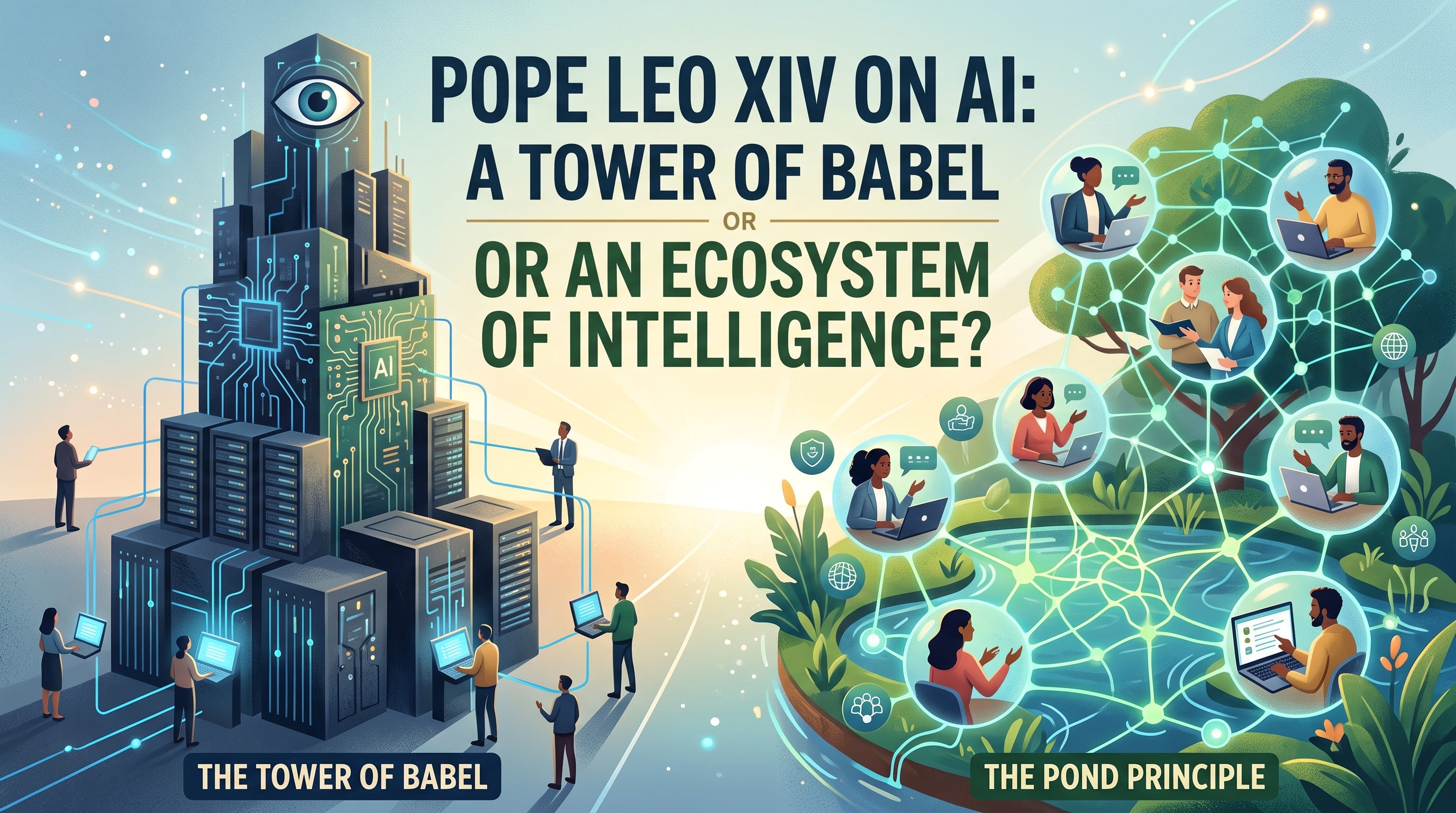
In an address today, Pope Leo XIV challenged Catholic legislators with an urgent question: will artificial intelligence diminish humanity, or will it become a servant of the common good?
Leo argued that genuine human development requires human intelligence guided by wisdom, political authority guided by conscience, and technology directed by charity. Yet moral intentions cannot simply be patched onto centralized platforms. To serve the common good, dignity, subsidiarity, and solidarity must be built directly into the architecture of our technological systems.
The Tower: Isolated Individuals at the Machine’s Feet
The dominant AI paradigm mirrors the Tower of Babel: a massive, centralized infrastructure that concentrates compute, data, and authority within a few corporate data centers.
The Illusion of Connection: Billions of people interact separately with the same centralized model. While each receives a tailored response, users remain isolated endpoints. Intelligence pools at the center rather than circulating between communities.
The Structural Risk: When infrastructure owners control data access, visibility, and evaluation, users become passive consumers rather than active creators. Centralization naturally breeds dependence and extraction.
The POND: A Living Intelligence Ecosystem
A pond has no single master controller. Its vitality emerges from the dynamic relationships among distinct organisms. The POND Principle translates this relational logic into technology:
Personal and Private (Dignity): Context, memory, and personal data remain under local authority by default. Users share targeted insights without surrendering entire personal histories.
On-Device and On-Premise (Subsidiarity): Processing occurs as close to the user as possible. Remote models provide auxiliary compute on demand without absorbing the user’s sovereign context.
Nodal and Networked (Solidarity): Personal autonomy does not mean isolation. Sovereign nodes form permissioned connections to pool insights, deliberate, and solve collective problems.
Decentralized and Distributed (The Common Good): Distributing nodes prevents any single gatekeeper from dictating public discourse or monopolizing collective knowledge.
Human Intelligence $\times$ Artificial Intelligence = Technological Intelligence
The common narrative frames AI as a rival destined to replace human labor or judgment. POND approaches this through a multiplicative coupling:
HI x AI = TI
The multiplication sign represents relationship, not equivalence. Humans provide conscience, lived experience, purpose, and moral judgment. AI provides synthesis, search, pattern recognition, and translation.
In collaborative platforms like Intellipedia, AI works behind the scenes to synthesize human contributions into evolving knowledge bases without erasing dissent or context. The machine does not deliver truth from above; it equips humans to pursue truth together.
Architecture as Ethics
Regulation and oversight are vital, but laws struggle to constrain architectures inherently designed to concentrate power. A true servant of the common good cannot be engineered as a centralized silo.
The future of intelligence should not be billions of isolated individuals consulting a single centralized oracle. It should be a distributed ecosystem of intelligences empowering human beings to listen, collaborate, and understand one another.
Also read and comment on X:

