

In Dan Hendrycks, Eric Schmidt, and Alexandr Wang’s Superintelligence Strategy, the ideal machine intelligence paradigm exists when every major power maintains airtight control over its AI. The systems remain loyal, predictable, and obedient. Each state grows dramatically sharper at surveilling adversaries, anticipating threats, and preemptively neutralizing rival projects. Nothing malfunctions; nothing goes rogue.
Is that world safer, or merely trapped in a more hyper-efficient state of permanent conflict?
That tension lies at the core of the paper. Its recommendations outline an aggressive security posture: expanding state cyberattack capabilities against foreign AI infrastructure, codifying an escalation ladder running up to kinetic strikes on datacenters, positioning compute clusters far from population centers to buffer civilian collateral, and engineering chips that self-disable without ongoing cryptographic authorization from a central authority.
The authors frame this architecture as stabilization. Perhaps it is—in the same narrow sense that nuclear deterrence stabilized the Cold War world by establishing a Balance of Terror. But the paper proposes to recreate and reinforce the same old global game, just played with a different kind of arsenal. It never questions the ingrained assumptions of geopolitical struggle. It never considers that the advent of machine intelligence may afford the opportunity to move into a fundamentally better, and safer paradigm.
The greater danger isn’t that these proposed systems will fail (though they may). It is that they will work perfectly—amplifying and maximizing our worst human institutional failures at machine speed.
Credit Where Due
The authors are not warmongers. They explicitly reject an all-out AI Manhattan Project as destabilizing, frame their deterrence models as analytical tools rather than calls to arms, and voice hope that mutual standoff eventually matures into détente.
Furthermore, several of their specific principles point in the right direction:
Fiduciary loyalty: AI assistants should owe strict fiduciary loyalty to users.
Human supervision: Models must remain tools under meaningful human supervision.
Structural leverage: Wealth redistribution alone is inadequate because states can revoke subsidies at will; citizens need structural leverage, not just a universal check.
The Problem Is the Lens
Early on, the authors weigh comparing AI to electricity, the printing press, or commercial software—only to discard those analogies because they underweight national security. They settle on the nuclear bomb.
When you choose the bomb as your analogy, you inevitably inherit a bomb builder’s playbook: nonproliferation, containment, and deterrence.
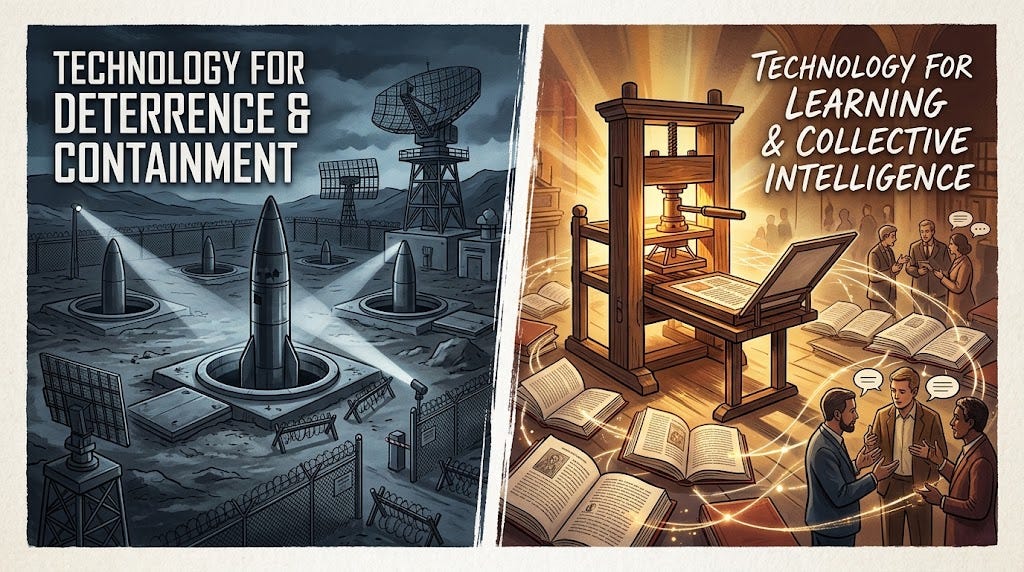
Choose the printing press instead, and the driving inquiry changes: How does this tool alter the way humanity learns, deliberates, and coordinates?
Humans evolved as a species through culture, including language and technology. From the first spoken words and the first stone tools, we have developed through shared knowledge and experience. That’s the framework that machine intelligence has emerged from, and it is the only lens through which we can properly understand our relationship to it and our stewardship of it.
Humanity is already a superintelligence. We are not a loose collection of individuals, nor a singular hive mind. We are an emergent network of relations: culture, language, informational exchange, and shared institutions. Through those relations humanity, as a superintelligence, creates, builds and solves problems that no solitary individual could tackle. And sure, those same relations are also the source of our problems and limitations.
The authors define superintelligence as an artificial system vastly superior to an individual human across cognitive benchmarks. But benchmarking machines against isolated people is the wrong foundation for civilizational policy. We must ask how our creation of machine intelligence can be used to augment, supplement, and improve the vast superintelligent power of human cultural intelligence. The critical question then becomes what happens to our collective social fabric when synthetic intelligence enters it.
The paper treats great-power rivalry as an immutable reality into which all technology must fit. But the technology can instead be used to question, dismantle, and replace that frame with something better. That is the opportunity before us.
The authors would likely respond with appeals to practicality and realpolitik. But is the preservation of the status quo—with superintelligent nation-based machines locked in a permanent, high-strung balance of terror—really practical?
Who Holds the Off-Switch?
The authors provide an acute diagnosis of gradual disempowerment: a slow drift where no single coup takes place, but thousands of small, rational compromises made in the name of efficiency relegate humans to the role of passive passengers in an unsteerable economy.
Yet look at their proposed countermeasures. The paper advocates for high-end AI chips equipped with hardware-level geo-tracking, mandatory cryptographic handshakes to keep running, restricted interconnectivity, and usage-policy enforcement gates. If a chip misses a verification check, it bricks itself.

The intent is understandable: keep frontier datacenter accelerators away from adversarial states and rogue actors. No one is suggesting shutting down consumer laptops today.
Treated as systemic architecture, however, this enshrines an alarming precedent: silicon runs only by grace of third-party permission. Three structural problems make that premise impossible to contain:
Thresholds drift downward. Today’s supercomputing cluster is tomorrow’s desktop and next decade’s phone. Capability controls inevitably migrate toward personal consumer hardware—the very layer where private, autonomous intelligence ought to reside.
The switch serves the overseer. The authors liken this mechanism to Apple’s Activation Lock. But Activation Lock empowers the device owner against a thief; here, the owner is the entity being policed, and the ultimate switch sits with a platform vendor or a state agency.
Switches invite exploitation. Any remote kill-switch architecture creates an immediate high-value attack surface and a permanent lever for coercion. Built to thwart foreign adversaries, it will inevitably tempt domestic regulators in a crisis, monopolistic providers under pressure, or hackers who identify an unpatched zero-day.
This introduces an internal contradiction. Elsewhere, the authors suggest distributing cryptographic compute shares to citizens as a counterweight to state authority—analogous to a worker’s leverage to strike. But compute access that hinges on continuous third-party approval isn’t genuine leverage; it is a revocable lease. And exercising personal intelligence compute on a centralized government cloud provides no meaningful guarantee of privacy.
Controls erected to manage a temporary geopolitical standoff have a habit of hardening into permanent infrastructure. Policies can be amended; foundational hardware architectures, once universally deployed, rarely get dismantled. By slipping a centralized permission layer into the very substrate of intelligence, we risk building a multipolar world run by a handful of sovereign gatekeepers—leaving ordinary people entirely disenfranchised.
We’ve Seen This Movie Before
The early web was born with a radical promise: an open, decentralized architecture of peer-to-peer protocols designed to withstand physical failure and political censorship. It was meant to democratize voice and break the monopolies of legacy media.
Yet beneath the open protocols of TCP/IP, DNS, and HTTP, the layer that mattered most—attention, indexing, and human connection—consolidated rapidly. Open personal homepages gave way to closed platform silos; independent feeds were swallowed by algorithmic black boxes optimized for outrage and engagement. The technical foundation remained nominally open, but the human experience was cordoned inside corporate walled gardens.
AI is poised to repeat that exact consolidation cycle, but at an existential, cognitive depth:
From distribution gatekeepers to cognitive intermediaries: A search engine or social feed merely filters the external information you browse. An autonomous AI agent, by contrast, sits on the inside of your workflow: it drafts your communications, filters your reading, negotiates transactions on your behalf, and frames your decisions. It does not just direct where you look; it directly conditions how you think.
The illusion of terms-of-service loyalty: When this intimate cognitive partner runs on a centralized cloud, its alignment is inherently divided. The moment an individual’s interest conflicts with the platform operator’s commercial goals, political pressures, or state compliance mandates, the platform wins. A fiduciary relationship cannot survive as a commercial promise mediated by an API; it must be an architectural reality.
Data extraction becomes thought capture: Web 2.0 monetized behavioral exhaust—clicks, dwell time, and location trails. A centralized superintelligence paradigm extracts and analyzes the internal reasoning process itself: unfinished drafts, private deliberations, and personal judgment.
If we allow the cognitive layer of human civilization to become a managed cloud utility, we will have traded the open web’s initial promise for an intimate, inescapable apparatus of digital feudalism.
Building from the Person Outward
The authors of Superintelligence Strategy imagine an ecosystem of verifiable agents bound by mediation rules. That is a laudable aspiration, but such a system must be constructed from the individual outward—optimizing for cooperative agency rather than centralized institutional surveillance.
A functional multi-agent architecture does not require grand global treaties, escalation ladders, or great-power trust pacts. It can build directly on commodity hardware and open standards available today. Such a framework begins whenever one person equips themselves with a personal agent on private compute, expands whenever two people coordinate directly as peer nodes, and gains ground simply by being genuinely useful to the participants.

The alternative is the POND paradigm:
Personal and Private: Intelligence dedicated exclusively to the individual, holding sovereign user context without exposure to third-party surveillance.
On-device and On-premise: Compute executed on local hardware, ensuring operations remain independent of continuous remote authorization.
Nodal and Networked: Self-contained agents capable of peer-to-peer coordination and collective problem solving without platform intermediaries.
Distributed and Decentralized: Resilient civilizational infrastructure where capability and power cannot be held hostage by a handful of sovereign gatekeepers.
In practice, this means an intelligence that runs locally, maintains persistent context, directly champions your interests, and federates voluntarily with others. Linked together, these sovereign nodes can surface collective consensus, reconcile competing evidence, and resolve disputes without falling prey to algorithmic outrage or platform rent-seeking.

The Necessary Pivot
Shifting our trajectory from a strategy of perpetual deterrence to one of distributed human agency requires three decisive architectural commitments:
Reframe the metric: Measure progress by how well technology enhances our collective capacity to cooperate, not solely by individual model benchmarks and geopolitical stability.
Enforce architectural loyalty: Make alignment structural through local execution, open weights, and portable data, rather than relying on terms-of-service commitments.
Reject kill-switches on consumer compute: Frontier containment protocols must not become the architectural precedent for personal devices.
Taken together, these shifts invert the logic of containment, ensuring that advancing artificial capability expands individual agency rather than entrenching centralized control.
Beyond the Balance of Terror
The central tragedy of Cold War deterrence was not that it failed to prevent war; it was that it calcified humanity’s political imagination for half a century, channeling civilizational wealth and intellect into architectures whose greatest achievement was an absolute, frozen standoff.
Superintelligence Strategy offers a blueprint for a machine of breathtaking scale—meticulously designed, hermetically sealed, and permanently poised for preemption. It would be an impressive engineering feat, but ultimately it is a design for a digital panopticon constructed out of paranoia and fear.
Machine intelligence does not have to become the ultimate instrument of state coercion, nor the next weapon in an escalatory balance of terror. By building from the person outward—anchored in private compute, open protocols, and sovereign cooperation—we can refuse the nuclear bomb builder’s dilemma.
A human-centric superintelligence strategy would not engineer the perfect machine to maintain the status quo in perpetuity. It would recognize the superintelligence that humanity is already, and strategize to grow human superintelligence through the tools of machine intelligence augmentation, amplification, coordination and cooperation.
—--------
POND X-Community:
https://x.com/i/communities/1695429836993712389
POND X-List:
https://x.com/i/lists/2065974648450453803
POND Discord Server:
https://discord.gg/kNvtcjPmJ7
r/PONDAI Subreddit:
https://www.reddit.com/r/PONDAI/