

This essay was originally published on POND
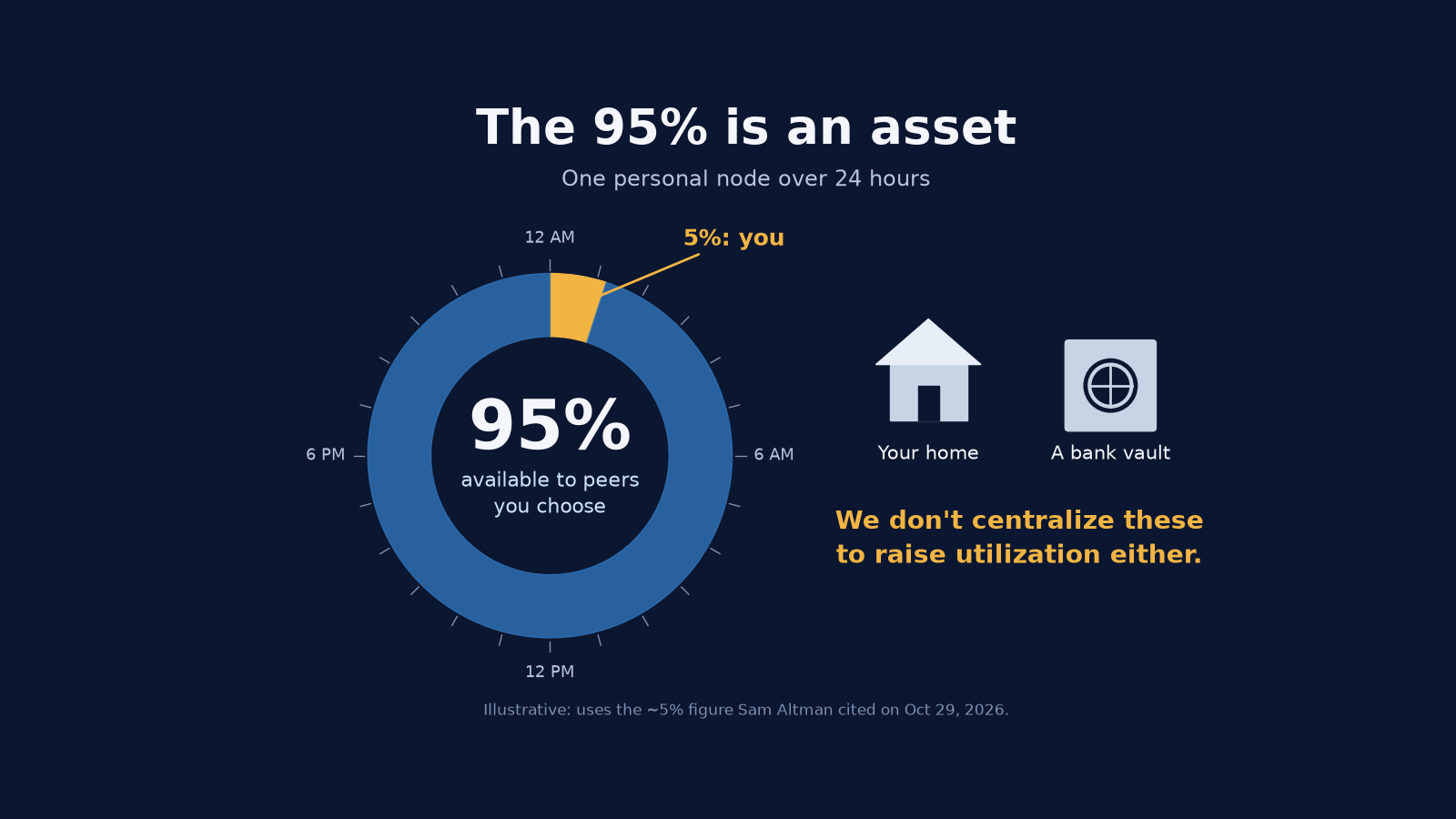
On October 29, 2026, Sam Altman said something worth taking seriously, because it says more than he may have meant to. Running AI locally, he argued, is a “quite terrible” use of the world’s scarce DRAM. The memory sits in people’s own computers, and those computers are only in use about 5% of the time. (clip)
On its own terms, the logic is tidy. Memory is scarce. Data centers keep it busy around the clock. Your laptop leaves it idle most of the day. So the efficient move is to put the memory where it gets used, in the cloud, and rent intelligence back to you as needed.
I want to take the argument seriously, because I think it’s wrong in three ways. Efficiency isn’t the only value. The idle 95% isn’t waste; it’s an asset. And calling local AI wasteful isn’t really an engineering claim. It’s a claim about who should own the commanding heights of the intelligence economy.
Efficiency is not the only value
By Altman’s measure, almost everything we own is badly allocated.
Your house sits empty most of the workday. Your car is parked most of its life. Your kitchen, your bookshelf, your guest room all have terrible utilization rates. A bank vault is a big, expensive room that mostly holds things nobody is touching.
We could fix all of that. We could centralize housing into shared pods rented by the hour. We could pool everyone’s valuables into one giant vault run by one company, and let you visit when you need them. Utilization would soar.
We don’t, and not because we can’t do the math. People own things because ownership is where privacy, control and freedom live. A home isn’t a lodging service with poor uptime. It’s the place where you decide who comes in.
Personal intelligence is the same. The memory in your machine isn’t just storage for model weights. It holds your context: your history, your documents, your decisions, your relationships. In a Human-Machine Intelligence (HMI) world, that context is the human half of the partnership. Moving it to someone else’s data center for the sake of utilization isn’t an efficiency gain. It’s a transfer of control.
Efficiency is a good servant and a bad master. When a utilization chart becomes the argument for who should hold your mind’s working memory, we’ve let the servant run the house.
The idle 95% is an asset
There’s a second problem with the 95% argument. It assumes idle capacity can only be fixed by centralization. That was the logic of the mainframe era: expensive machines, so share them from the center.
But there’s another way to raise utilization, and the internet already showed it to us. Connect the edges.
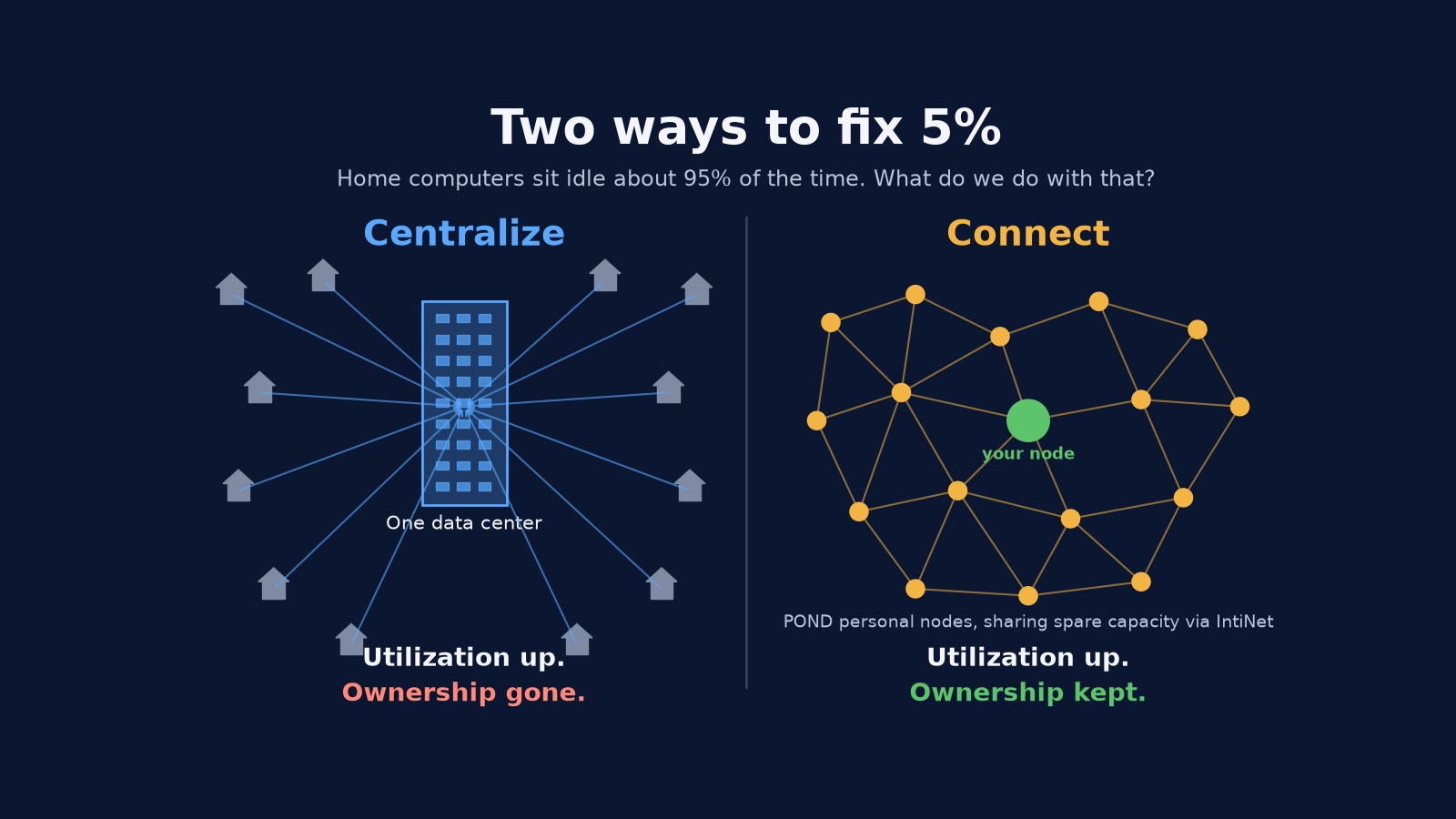
Think about what that idle 95% actually is. Billions of devices with memory, compute and storage, sitting mostly unused, owned by the people who bought them. Altman sees that as waste to be reclaimed by moving the memory into a data center. I see it as the largest distributed compute resource on Earth, waiting for a way to cooperate.
Why the edge sits idle
Edge capacity is underutilized because nobody’s engineering to enable the edge intelligence that could use it. The reigning paradigm says there’s only one way to do machine intelligence: centralized and vertical. So the memory and compute in our homes sit dormant, not because they’re useless, but because almost no one is building for them.
Enable personal nodal intelligence through consumer-friendly user experiences and that utilization will max out very quickly, unlocking a vast, dormant economic asset. It’s like having a gigantic reserve of valuable energy just under the surface, untapped, like crude oil before anyone knew what to do with it.
That’s what POND personal nodes are built for. Each person’s environment is a node: their own hardware, running their own intelligence, holding their own context. And nodes can connect, voluntarily and peer to peer, to share what they choose.
At Intelligence Systems, we’re building Inti, a POND personal node technology, with that in mind. Through IntiNet, personal nodes can offer spare capacity to peers they trust: a family sharing one strong home machine, a small team pooling GPUs overnight, a community lending capacity to a member who needs it. Your node stays yours. When you need it, it’s there. When you don’t, the idle time can do useful work for people you’ve chosen to work with, on your terms.
That changes the math. The 95% isn’t a reason to give up local intelligence. It’s the reason local intelligence can scale. Utilization goes up without ownership going away.
It also fits how intelligence actually works in practice. As I’ve argued before, POND systems shouldn’t depend on one giant model doing everything. They should distribute the workload across a system of interactions: your node, its tools, its memory, smaller specialized models, and peers you choose. A network of owners can do that. A network of renters can’t.
Wasteful is a word for the chokepoints
So why frame local AI as waste at all?
Will Manidis and Joe Roberts’ essay “The Commanding Heights” offers a useful map. Their case, as I read it, is that frontier models become commodities quickly, and the lasting fortunes go to whoever holds the scarce positions that intelligence has to pass through. Compute. Memory. Interfaces. Data.
Read Altman’s remark against that map and it comes into focus. DRAM is one of those scarce positions. If memory belongs in data centers, then the chokepoint belongs to whoever owns the data centers. “Terrible allocation” sounds like an engineering judgment. Functionally, it’s an argument for where the toll booth should go.
Google DeepMind’s essay “The Economics of Intelligence“ points at the bigger stakes. One line of its argument is that the solo AI agent is the wrong economic object; the real transformation comes when agents can coordinate. I agree, and the next question is the one that matters most: coordinate for whom?
If every agent is a tenant on one lab’s cloud, coordination collapses into a few giant firms. The memory is theirs, the context is theirs, the market is theirs. If every person owns their own agent on their own node, coordination becomes a market of peers: people whose personal AIs find each other, negotiate terms, solve a problem together and move on when the work is done.
Those are two very different economies built from the same technology. The difference isn’t the model. It’s who owns the commanding heights.
There’s one commanding height almost nobody is pricing in, and it’s the individual. When your personal AI runs on hardware you own and holds your own context, you’re a node in the network, not a customer on someone else’s toll road. That’s why the 95% framing matters. If we accept that personal memory is waste, we’ve conceded the one height that ordinary people already hold.
What the 95% argument gets right
To be fair, Altman is pointing at something real. Memory is scarce right now. Frontier training and serving at scale need enormous data centers. Some tasks really do need the frontier, and the cloud will keep a role.
But the conclusion doesn’t follow. The fact that some work belongs in the data center doesn’t mean your context does. And the scarcity of DRAM is an argument for using all of it well, including the memory already sitting in billions of homes, not for routing everyone’s intelligence through a handful of buildings.
The healthy default is the one I’ve argued for before: everyday intelligence runs on hardware you own, and you reach for the cloud by choice, not by necessity.
The POND Principle
The POND Principle describes where this leads: Human-Machine Intelligence that is
Personal & Private: intelligence that starts with the person and keeps their data, identity, memory and context under their control. Your memory isn’t waste. It’s yours.
On-Device & On-Premise: intelligence that runs on hardware the person or community owns. Idle time is the price of ownership, and ownership is worth it, the same way a home is worth more than a rented pod.
Nodal & Networked: each person’s environment is a node, and nodes connect voluntarily, peer to peer, sharing only what’s authorized. That’s how the idle 95% becomes shared capacity without becoming someone else’s property.
Decentralized & Distributed: a counterbalance to centralized AI, with no single authority owning or controlling the network, or the memory it runs on.
Humanity is already a kind of superintelligence: an emergent network of people, language, knowledge and exchange. The goal isn’t to move that network’s memory into a few data centers to improve the utilization chart. It’s to give every person a node and let the network get stronger.
The 95% isn’t the problem. It’s the opportunity. It’s crude oil before anyone knew what to do with it, and the personal node is how we tap it.
Join the POND
If you’re a builder, a thinker, a policy-maker or simply someone who wants the intelligence in your life to work for you, come help build what comes next.
Start at pond.is
Join the conversation on Discord, including the weekly PONDcast
Write to us at foundation@pond.is
Your computer isn’t idle. It’s waiting. Welcome to the POND. 🐸