

Environmentally Adaptive Intelligence Phase:
Survival and Subsistence, Skills and Tools
3.3 million to 50,000 Years BP
During the phase of Environmentally Adaptive Intelligence, from about 3.3 million to 50,000 years ago (roughly coincident with the geological Pleistocene Epoch), human Intelligence evolved primarily through the adaptive response of biology, physiology and genetics to environmental pressures. Driven by the struggle for survival and subsistence, early hominins expressed their adaptive genetics through evolving bodies, growing brains and emergent cognitive powers to solve problems that facilitated better survival outcomes on an individual and small group basis.
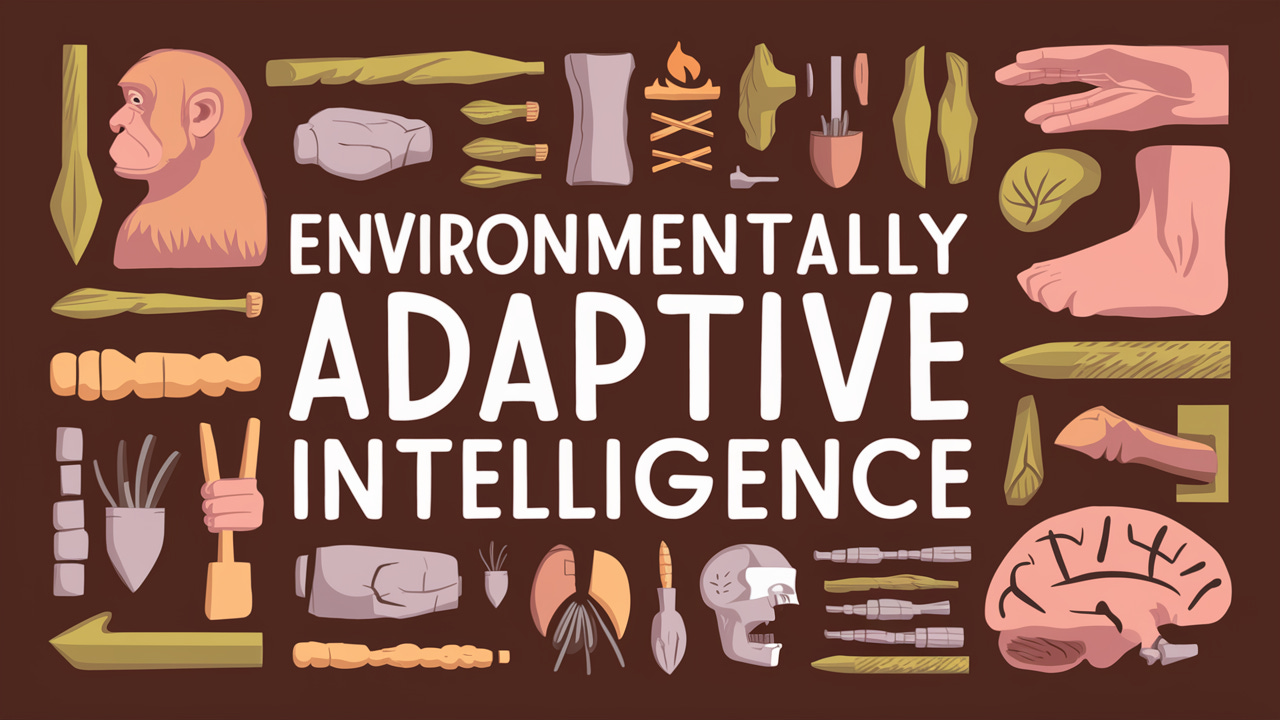
This phase saw the evolutionary completion of the human biophysical substrate, but it also was the dawn of discrete and cultural intelligence attributes. Early humans learned to make tools, create and control fire and communicate through spoken language.
Compositional Agency
(3.3 million to 300,000 years BP)
“The hand is the cutting edge of the mind…The hand axe is the first step to the knife and the sword. But it is a step in another direction as well. Man realizes that the world is made up of separate objects, and these objects can be shaped and combined to make new objects. This is the beginning of invention, of technology.”
— Jacob Bronowski, The Ascent of Man
During the Lower Paleolithic period various species of the genus Homo, such as Homo habilis and Homo erectus, co-existed and competed. They were constantly faced with extreme environmental pressures and were frequently prey for larger, stronger predator animals.
Opportunistic tool use by hominins had been common for millions of years. They had intelligently observed that the environment was made of various objects that could be used as an extension of the mind and the hand to facilitate survival and subsistence. Using rocks and sticks and pieces of bone, they could smash, cut, poke, dig and more to perform a variety of work tasks.
Early humans then became aware that these environmental objects could be intelligently improved.
They learned that objects had composition and through the application of force and skill they could be decomposed and recomposed in various, useful ways. They evolved from being passively molded by the environment, like the plants and animals, into nascent agentic intelligences acting upon their natural context through the creation and use of primitive tools.
The deliberate manipulation of environmental factors to create new objects of utility marked a transformative leap in Intelligence evolution from animalistic behaviors to conscious problem-solving — the dawn of technology as an extension of the mind. Homo faber, “the human who makes”, was born through this new evolutionary Intelligence of Compositional Agency.
There are two essential components here that together represent a qualitative evolutionary leap relative to both the animals and the prior mode of opportunistic tool use.
Agency refers to the intentionality driving actions. It implies a conscious choice and a directed effort to manipulate the environment rather than a simple, instinctive reaction to it, distinguishing human cognition from that of lower primates and other animals.
Composition references the cognitive comprehension of the nature of things as being composed of smaller subunits of similar material as well as the observational awareness of the pattern of their construction. This understanding led hominins to agentic action upon the materials. The decomposing, recomposing and organizing of the elements of the environment into useful configurations represented an advanced level of cognitive engagement with the physical world encompassing the perception of possibilities and creation through experimentation.
Early tools were used to overcome survival and subsistence pressures in a variety of shaping, decomposing and recomposing applications, including:
Butchering animal carcasses: Sharp stone flakes and chopping tools were used to cut through tough hides, remove meat from bones, and extract nutrient-rich marrow.
Processing plant foods: Stone tools were used to dig up tubers and roots, crack open nuts, and strip bark from trees to access edible parts.
Hunting and scavenging: While the extent of hunting in the Lower Paleolithic is debated, some researchers suggest that early hominins may have used tools like wooden spears or thrown stones to hunt small game or defend scavenged carcasses from other predators.
Shelter and protection: Early hominins likely used tools to construct simple shelters, such as modifying natural features like rock overhangs or building basic structures from branches and vegetation. Tools could also have been used for defense against predators.
Through the intelligent observational awareness of materials composition and the agentic application of skill and force, early humans created these evolutionary adaptations and thereby began the process of separating themselves from the animal kingdom, initiating the long march towards increasing freedom from environmentally adaptive pressures and the gradual assumption of a primarily agentic status.
Causal Reasoning
(400,000–300,000 years BP)
Towards the end of the Lower Paleolithic period a relatively new species of hominin, Homo sapiens, was responsible for the next definitive leap of human Intelligence evolution when it learned to intentionally create and wield fire. While the opportunistic use of environmentally available fire had likely been common throughout the Lower Paleolithic, the intentional creation of fire is considered a significant milestone in human Intelligence evolution.
The creation of fire can be seen in part as an extension of the compositional cognitive abilities associated with tool making, but it also reflects a significantly more advanced form of intelligence. Breaking down, shaping, recomposing and arranging materials is a much simpler set of cognitive operations than those required for fire-making. The intentional production of fire is a complex technological innovation that requires a range of cognitive abilities including observation, abstraction, problem-solving, planning and most importantly, an understanding of cause and effect. Taken together, these cognitive attributes comprise the Intelligence evolution of Causal Reasoning.
Whereas primitive tool making involved the decomposition and recomposition of environmentally extant elements, fire-making represented the causal creation of an unavailable, non-existent element from other available elements, an act of distinct creativity.
The creation of fire by the striking of flint first required the observation that naturally occurring fire (from lightning or volcanos) and the spark seen when certain rocks were struck together both shared the properties of heat and light. It also required the observation that it was only certain kinds of rocks struck in specific ways that produced the effect. Similarly, the production of fire through intentional friction would have required the observational awareness that fire is hot and that when two pieces of wood are rubbed together, a similar heat is produced. Through Causal Reasoning the early Homo sapiens arrived at an understanding of the properties of different materials and the way that they interact with each other in a specific way to produce a spark or ember.
The conjuring of a flame must have seemed magical to the early human. Working with such a mysterious force with a seeming chimerical will of its own required a certain audacity that speaks to an inner spark of agentic power. While fire-making was an adaptive response to the environmental pressures of survival and subsistence, it was also a significant furtherance of human agency.
The ability to create and control fire provided a source of heat against the cold, light to extend the day, protection from fearsome predators and energy for the transformation of raw food. Using fire, humans proactively pushed back against the coldness, darkness, rawness and predatory dangerousness of their natural circumstances.
The cooking of food facilitated vastly improved survival and subsistence outcomes. Cooking made food safer to eat, easier to digest and more nutritious, supporting the growth and evolution of the human brain and other biological systems. It also fostered cognitive skills such as preparation, staging, planning and the perception of time.
Fire was likely the catalyst that bootstrapped early cultural attributes. It’s easy to imagine that the adept fire-maker enjoyed a significant status in early human society. At the same time, the creation and use of fire would have been the focal point of shared group interactions.
Cooking food with fire fostered the emergence of social structures through division of labor, task specialization and communal meals. Skill sets developed involving the creative combining of tools, vessels and heat to prepare and transform raw food into cooked meals.
The human relationship to fire was probably linked to the emergence of rudimentary language. Spoken language would have been required to communicate and share the knowledge of how to create and maintain fire, passing it down from generation to generation and between populations.
With the creation of tools and the mastery of fire early humans clearly distinguished themselves from other forms of life. Whereas plants and animals conform to environmental pressures, reshaping biology and behavior in order to survive, humans pushed back, decreasing and deflecting survival and subsistence pressures with intelligent creativity. While animals adapt physically and behaviorally to environmental pressures, humans adapted but also evolved their cognitive Intelligence.
In the subsequent period, the human species would push even further into its agency through the development of the first information technology, spoken language.
Representational Language
(300,000 to 50,000 years BP)
In the Lower Paleolithic period, early rudimentary verbal communication likely supported the emergence of tool and fire culture. Fossil and paleogenetic evidence suggests that during the Middle Paleolithic period humans developed the modern anatomical and genetic basis for verbal communication. The evolution of the physical basis for speech around 300,000 years ago was the final set of biological adaptations that established the present human physical body.
Coincident with these biological physical adaptations, early humans evolved an increasingly sophisticated and varied set of cultural technological and societal adaptations that dramatically improved survival and subsistence outcomes and further extended and established hominin agency:
Scaling and complexification of tool and weapons making
Organization and planning of communal hunts
Establishment and building of primitive shelters
Creation of clothing
In conjunction with the development of these ever more sophisticated survival and subsistence strategies early humans created verbal Representational Language. As each new human activity produced a growing body of knowledge and expertise it drove the development of a specific vocabulary that encoded the necessary information required for a given task or technology.
Word-smithing represented a qualitatively more advanced order of Intelligence. To evolve a socially accepted word that symbolizes a thing or action or idea requires an abstract conceptual space in which a thing that is not a sound is represented by the verbal making of a sound and the sound is understood to represent the thing.
The mention of the socially accepted word representing “lion” in a Middle Paleolithic encampment would invoke a mental image of the beast as well as the imagination of a chain of possible scenarios and potential actions associated with it. This abstract representational space of Intelligence emerges as a direct consequence of linguistic relativity.
A community of humans with a shared vocabulary then effectively creates and colonizes a noumenal realm in which possibilities, potentialities and counterfactual outcomes can be considered. In this space a wide range of advanced cognitive abilities such as abstraction, categorization, differentiation and generalization would be fostered.
A new span of temporality also opens up with the establishment of spoken language. As a storage medium for information, experience, meaning and belief, language creates a duration into the past and a projection into the future that extends beyond the present of an individual or group. Memory is vastly expanded and planning becomes possible.
Spoken language is likely to have engendered other forms of Representational Language. Early song, storytelling and myth probably had its origins in the late Middle Paleolithic.
The first signs of symbolism and ritualistic behaviors also emerged. Simple geometric engravings found in some Middle Paleolithic sites may have encoded early symbolic meaning. Burial sites may have been associated with symbolic beliefs about an afterlife. Jewelry such as pendants, beads, and personal ornaments made from materials such as bone, shell, ivory, and animal teeth show the beginnings of decorative self-adornment. Pigments were used to create coloring for skin, garments and artifacts suggesting ritualistic purpose. All of these cultural developments can be considered forms of language, Representational Language which stored and transmitted information, meaning, value and belief.
World Model
At the beginning of the Environmentally Adaptive Phase, the World Model of the early hominin was primarily centered around the immediate environment and basic survival needs, including the location of food sources, water, and potential dangers. There was little distinction between the world of the early human and that of the animals and the general environment. The perception of time was likely limited to the cyclical rhythms of nature and the patterns of day and night and seasonality. Social structures were simple and constrained to the local clan, and cultural knowledge was primarily transmitted through observation and imitation within small, kin-based groups.
By the end of the Environmentally Adaptive Phase, the human World Model had undergone dramatic expansion and refinement. The physical World Model was now mentally mapped and extended into the local hunting and foraging territory with awareness of competing social groups. With the development of tools and the control of fire the world was now an environment that could be intentionally manipulated and shaped. Spoken language expanded the World Model to include a new inner universe of symbolic thought, a space for the storage of knowledge, the working out of plans and the theory of mind that facilitated social interaction. Through spoken language and oral history a temporal light cone now included memory of the past and transmitted accumulated knowledge and skills across generations into an anticipated future. Humans now saw themselves as distinct and separate from the environment and other animals. Early cultural elements in the form of proto-artworks may suggest the beginnings of spiritual beliefs.
Conclusions
The Lower and Middle Paleolithic periods saw a progressive human Intelligence evolution marked by the development of the cognitive powers of Compositional Agency, Causal Reasoning and Representational Language. Each of these was associated with significant practical innovations that addressed survival and subsistence challenges. In the course of adaptively pushing back environmental pressures, humans expanded their agency. Coincident with this process, the hominin evolved into its current form, the biological, physiological and genetic modern Homo sapiens. By the end of the Middle Paleolithic period, humans had developed the basis in physical and cognitive Intelligence to transcend the limits of the Environmentally Adaptive Intelligence phase and enter into the far greater powers of Cultural Intelligence.