

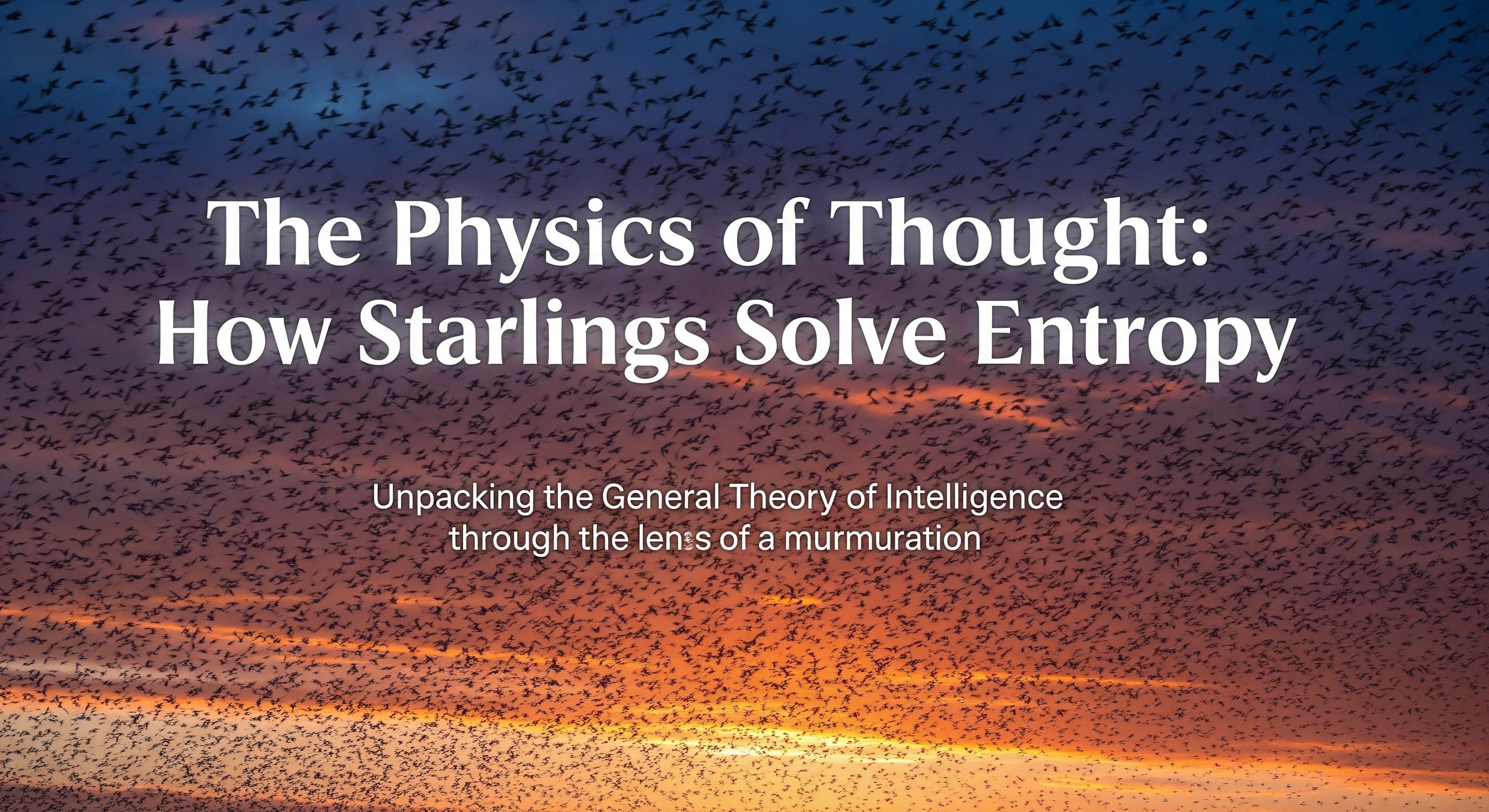
If you have ever stood in an open field at twilight and watched a starling murmuration, you know it doesn’t look like biology. It looks like physics. It looks like fluid dynamics. Thousands of birds twist, compress, and expand like a shape-shifting cloud, turning on a dime without a single collision.
It is breathtaking, but it is not magic. It is a visible, living computation.
These murmurations are nature’s masterclass in collective intelligence, and they provide a perfect physical analogy for the abstract General Theory of Intelligence.
When we strip away the feathers and the sunset, what we are watching is a particle system solving a complex problem in real-time. We are watching an Intelligent System emerge.
Defining the “Intelligent System”
To understand the flock, we have to step back and define intelligence not as “brain power,” but as a structural process. A compelling definition frames it this way:
An Intelligent System emerges from information exchanges across boundaries in a possibility search space, resolving domain entropy.
That’s a mouthful of theory. Let’s break it down using the birds.
1. Information Exchange Across Boundaries
In the General Theory, intelligence requires a flow of data across boundaries. In a murmuration, the “boundaries” are the physical limits of each individual bird.
Starlings don’t have telepathy. They operate on local interaction. Research suggests each starling tracks the seven closest neighbors around it. They exist in a state of constant, high-speed data swap: How close is my neighbor? How fast is the wind? Where is the falcon diving from?
The bird is the node; the air is the medium. They are swapping positional and velocity data across the boundary of “self” and “other” at millisecond intervals.
2. Navigating the Possibility Search Space
The flock moves through a 3D volume of air—this is their possibility search space.
In this space, there are infinite potential futures. In one future, the flock scatters and a hawk picks off a straggler. In another, two hundred birds collide mid-air. In another, they turn left when the wind pushes right, wasting energy.
The “intelligence” of the system is its ability to search this space instantly. The flock navigates infinite possibilities—predator trajectories, wind shifts, obstacle avoidance—and collectively selects the optimal path.
3. Resolving Domain Entropy
This is the crucial part. Entropy is a measure of disorder or uncertainty. A thousand birds flying randomly is a high-entropy state; it is chaotic, dangerous, and inefficient.
The murmuration is an entropy-resolving machine. Through those local information exchanges, the system reduces chaos. It collapses the uncertainty of “where should we go?” into a single, cohesive movement.
The result is adaptive order. The flock creates a shape that is low-entropy (highly ordered) but highly fluid (adaptable).
The Emergent Superorganism
The most fascinating aspect of this theory is the lack of a CEO. There is no “lead bird” barking orders. The intelligence is emergent.
It is a “superorganism” smart enough to evade a peregrine falcon, created entirely by individual agents following simple rules of physics and biology. The system resolves uncertainty at scale in a way that no single brain within it could manage alone.
Why This Matters
Viewing intelligence this way—as the resolution of entropy through information exchange—changes how we look at everything from AI to corporate teams.
It suggests that smart organizations aren’t necessarily the ones with the smartest leader at the top. They are the ones with the best information flow across boundaries. They are the ones where local units interact fluidly to resolve the chaos of the market (the search space).
The next time you see that dark ink-blot twisting in the sky, remember: you aren’t just seeing birds. You are seeing the raw architecture of intelligence, solving the problem of survival one wingbeat at a time.