


Most people think the future of AI looks like this:
More intelligence.
Applied everywhere.
Doing all the work.
All the time.
Smarter agents. Smarter robots. Smarter everything.
But that’s not actually how Intelligent Systems work.
They don’t problem solve on everything all the time.
They solve once, and then turn the solution into a repeatable process.
We’re building AI upside down.
A Cave Man, a Rock, and a Breakthrough
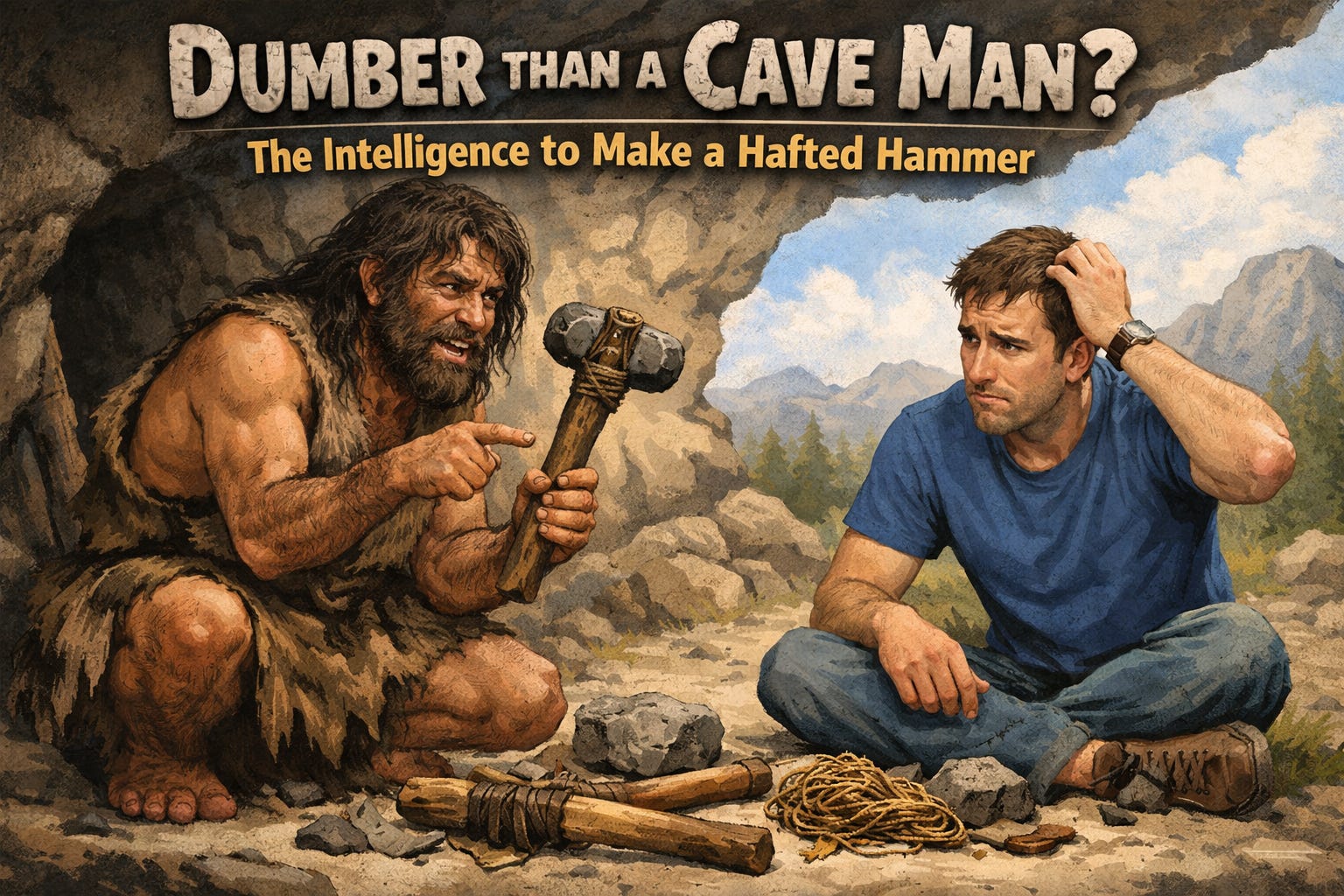
From a previous post: “Dumber than a Cave Man? The Intelligence to Make a Hafted Hammer.”
“Dumber than a Cave Man? The Intelligence to Make a Hafted Hammer.”
Imagine you’re dropped into the wilderness.
You need a hammer.
At first, it’s a huge challenge:
Which rock?
How do you attach it?
What won’t break on impact?
You experiment. You fail. You iterate.
That’s intelligence at work—resolving uncertainty.
Eventually, you figure it out:
the right stone
the right binding
the right shape
the right way to use it
Now you have a hafted hammer.
But here’s the key:
Once it’s figured out…
you don’t need intelligence anymore to make it.
You just follow the steps.
Then you teach it to your children.
They don’t have to relearn everything from scratch.
You show them the process.
Over time:
those steps get standardized
then optimized
then mechanized
Eventually, a factory produces thousands of hammers per hour.
No thinking required.
Where Did the Intelligence Go?
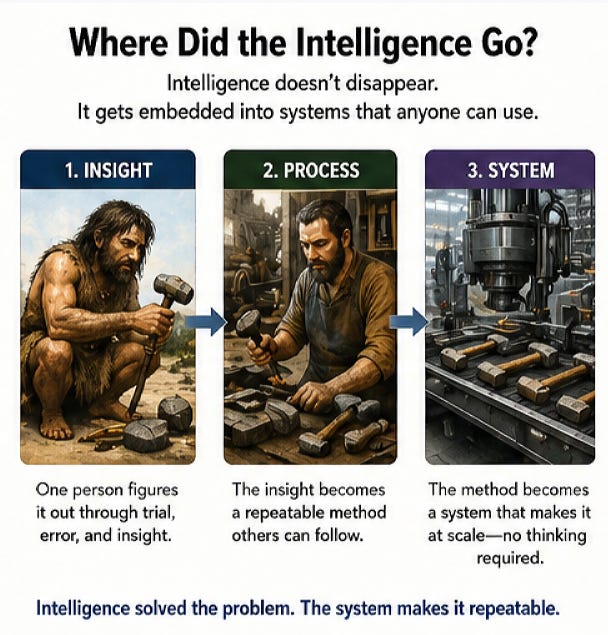
Intelligence doesn’t disappear—it gets embedded into processes that anyone can use.
It didn’t disappear.
It moved.
From:
a person figuring things out
To:
a system executing a solution
The intelligence is now:
in the design
in the process
in the system itself
This Is How Progress Actually Works
Every major advance follows the same pattern:
We use intelligence to solve a problem
We turn that solution into a repeatable process
We stop needing intelligence to execute it
Cooking. Manufacturing. Software. Logistics.
Even language.
What was once difficult becomes:
routine
automatic
invisible
So Why Are We Building AI Upside Down?
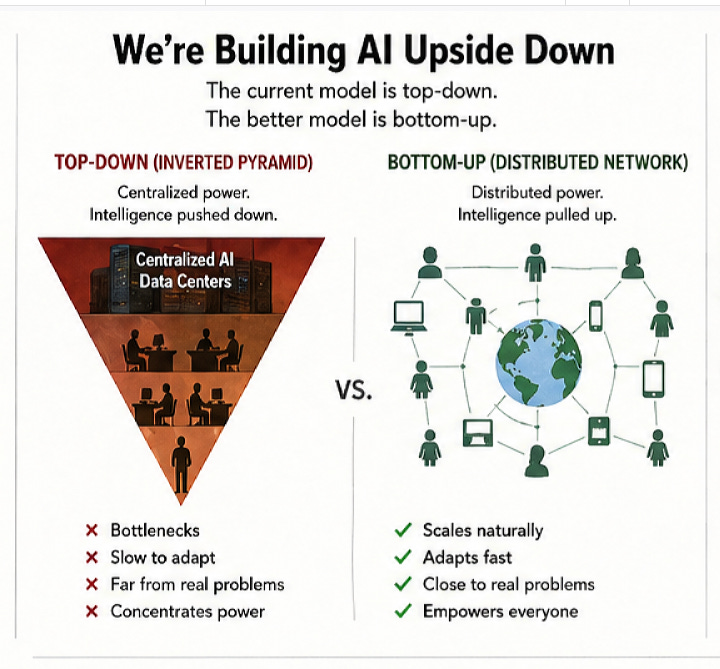
Centralized, top-down AI vs distributed, bottom-up intelligence that scales at the edge.
Right now, most of the AI conversation points in one direction:
Build bigger models.
Run them in massive data centers.
Let them do more and more of the work for us.
It’s a top-down vision.
A few centralized systems, doing everything.
But that’s the opposite of how intelligence actually scales.
Real intelligence doesn’t concentrate.
It distributes.
Think about how the hammer spread.
One person figured it out.
Then others learned it.
Then it became a shared process.
Then it became a system anyone could use.
The intelligence didn’t stay in one place.
It propagated.
That’s the model we should be building with AI.
Not systems that replace human capability from above—
But systems that enhance human capability at the edge,
and then distribute those improvements everywhere.
AI shouldn’t just do things for us.
It should help each of us do things better—
and turn those improvements into repeatable systems that everyone can use.
Bottom-up, not top-down.
That’s how intelligence actually spreads.
That’s what real Artificial General Intelligence should look like:
Not one system that does everything,
But intelligence that improves everyone—and spreads.
Intelligence Does Less Work, Not More
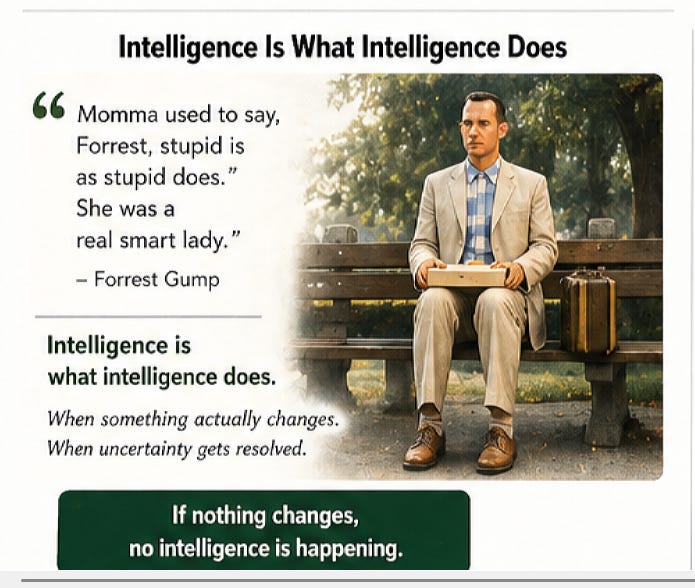
There’s a line from the movie Forrest Gump:
“Stupid is as stupid does.”
It’s simple, but it points at something deeper.
You could say the same about intelligence:
Intelligence is what intelligence does.
It’s for figuring out how to do less work and produce more.
Once something is understood:
it should become a process
then a system
then a mechanism
Then intelligence moves on to the next problem that needs solving.
That’s the moment intelligence shows up:
When something actually changes.
When uncertainty gets resolved.
When a new pattern becomes usable.
And once that happens, it shouldn’t have to happen again.
Two Kinds of Intelligence
It helps to think of intelligence in two forms:
1. Systemic Intelligence
This is intelligence that has already been solved and embedded:
assembly lines
software systems
infrastructure
standardized processes
It’s repeatable. Reliable. Invisible.
2. Dynamic Intelligence
This is intelligence in motion:
dealing with uncertainty
handling edge cases
solving new problems
This is where thinking actually happens.
A healthy system uses both:
Systemic intelligence handles the known
Dynamic intelligence handles the unknown
When Systems Become “Dumb”
This is the part most people miss.
People often say:
“Automation is dumb.”
But that’s not quite right.
Systems aren’t dumb.
They are stored intelligence.
They only become dumb when:
the world changes
but the system doesn’t
When the assumptions baked into the system no longer match reality.
That’s when intelligence has to come back in.
The Real Role of AI
This is where AI actually matters.
Not as a universal worker.
But as a system updater.
AI’s job is to continuously take new information
and fold it back into the system.
To:
detect where structure breaks
resolve new uncertainty
update the process
So that next time:
No intelligence is needed again.
The PDF Problem (and Why It Matters)
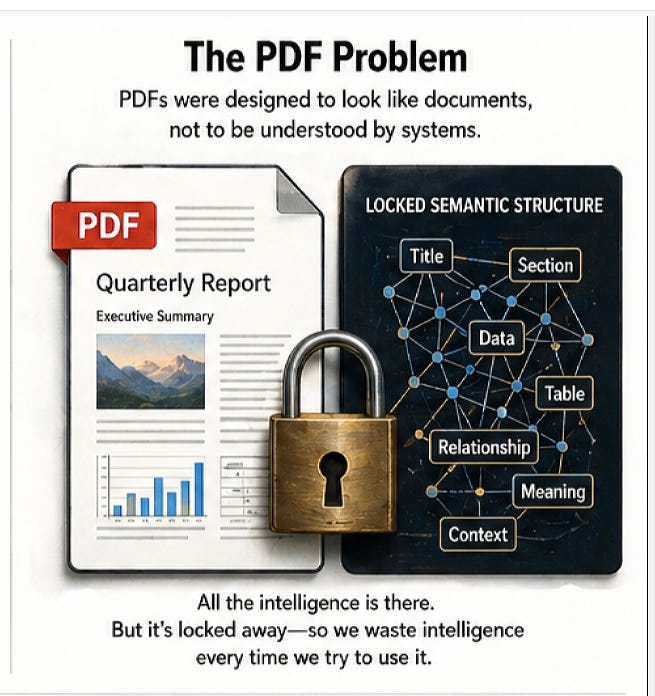
The intelligence is there—but locked away behind a format built for display, not understanding.
Here’s a concrete example of where we went wrong.
The PDF.
It was designed as a format to look at documents.
Not to understand them.
So what happened?
All the intelligence in the document is there:
structure
meaning
relationships
But it’s locked inside a visual format.
Now, every time we want to use that information:
We have to:
parse it
reconstruct it
reinterpret it
We’re spending intelligence
to recover intelligence that was already there.
At massive scale.
What We Should Be Building Instead
If we were doing this right:
Documents wouldn’t just be:
readable
They would be:
structured
semantic
directly usable
The intelligence would be embedded.
So systems could operate on them:
Without needing to figure them out again.
The Real Future of AI
The future isn’t:
AI doing everything.
It’s:
AI making most things no longer require AI.
fewer decisions
more structure
less repeated thinking
And intelligence focused where it actually matters:
At the edge.
Where something new is happening.
The Loop
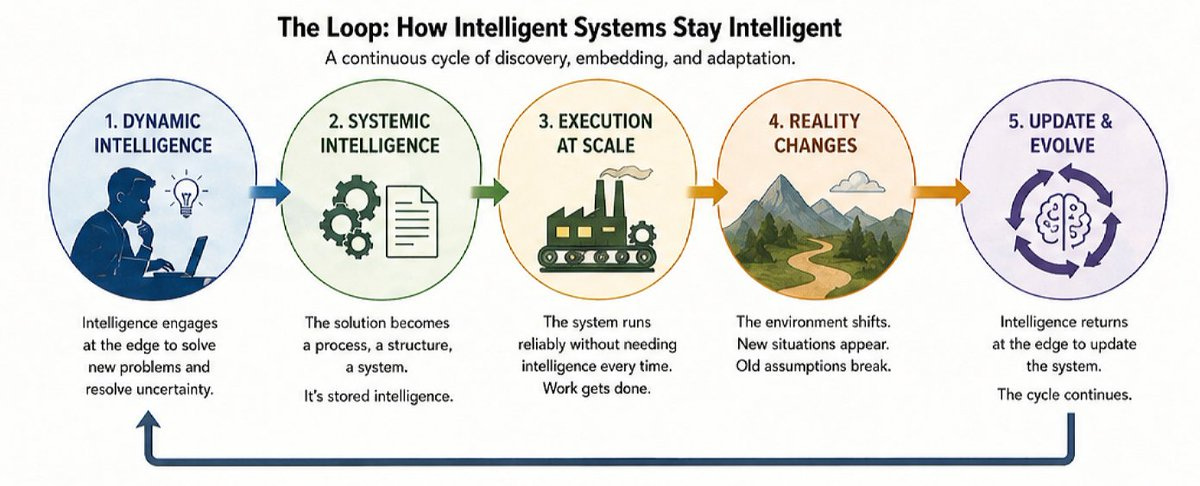
Dynamic intelligence becomes structure, executes, breaks, and gets updated—over and over.
This is the real cycle:
Intelligence solves a problem
The solution becomes a system
The system removes the need for intelligence
The world changes
Intelligence returns at the edge
The system evolves
Over and over.
The Bottom Line
Intelligence doesn’t scale by doing more work.
It scales by eliminating the need to do it again.
The most intelligent system is not the one that uses the most intelligence.
It’s the one that has already done the work of intelligence—
and doesn’t need to do it again.